

“Indirect Tax I Indirect Tax Litigation I Customs & FTP I Central Licensing I Arbitration I Advisory”
Dated: 09.09.2026
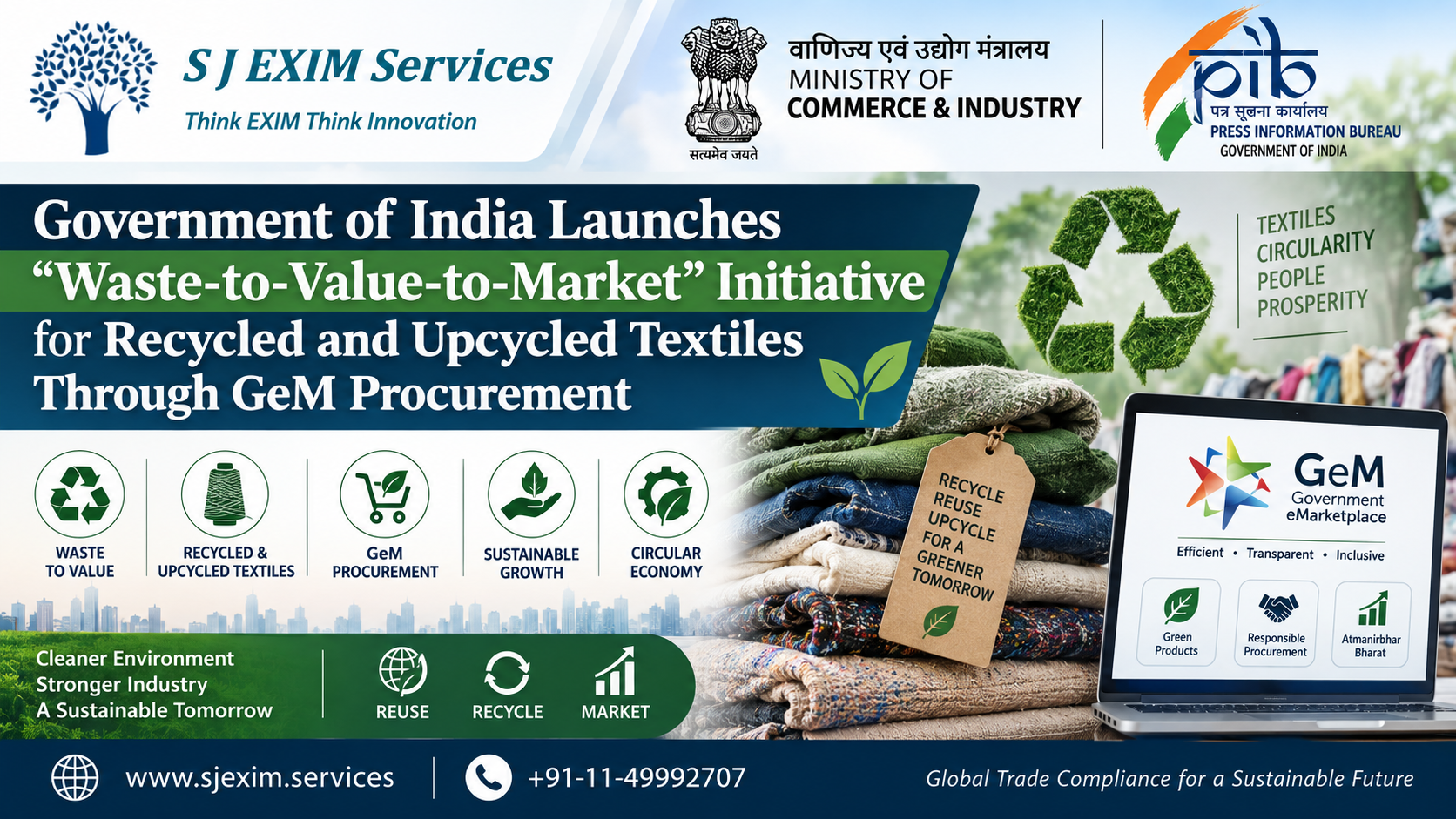
Government of India Launches “Waste-to-Value-to-Market” Initiative for Recycled and Upcycled Textiles Through GeM Procurement
The Government of India has launched a significant circular-economy initiative aimed at converting pre-consumer and post-consumer textile waste, scrap and second-hand clothing into value-added products for Government procurement.
According to the Press Information Bureau release, the Ministry of Textiles, through the Textiles Committee, and the Government e-Marketplace (GeM) have joined hands to promote recycled and upcycled textile products through public procurement. The partnership was formalised through a Memorandum of Understanding signed during the 62nd Foundation Day celebrations of the Textiles Committee in Mumbai.
The initiative seeks to create what the Government describes as a “Waste-to-Value-to-Market” ecosystem, under which discarded textile material can be transformed into quality, marketable products and supplied to Government buyers through GeM.
This development is important not only from the perspective of sustainability, but also for textile recyclers, upcyclers, MSMEs, women-led enterprises, artisans, local manufacturers and circular-economy businesses seeking access to institutional demand.
Why This Initiative Matters
India’s textile sector generates significant quantities of textile waste at different stages of the value chain.
This includes:
- pre-consumer production scrap;
- cutting and processing waste;
- post-consumer discarded garments;
- second-hand clothes;
- damaged textile products; and
- other reusable textile material.
Traditionally, a considerable portion of such waste has had limited formal market access, fragmented recycling channels or low-value downstream utilisation.
The newly announced partnership seeks to address this by linking recycling, certification, product development and Government procurement.
Instead of treating textile waste merely as a disposal problem, the policy approach attempts to convert it into a source of economic value, enterprise development and sustainable public procurement.
The “Waste-to-Value-to-Market” Model
The central idea behind the initiative is to create a structured chain:
Textile Waste → Recycling/Upcycling → Quality Product → Certification/Recognition → GeM Listing → Government Procurement
The PIB release states that textile waste, scrap and second-hand clothes will be transformed into quality value-added products, which will then be made available to Government buyers through the Government e-Marketplace.
This is particularly significant because Government procurement can serve as an anchor market.
Many recycling and upcycling businesses face the challenge of producing sustainable products without assured demand. By creating dedicated procurement channels, the Government is attempting to solve both sides of the equation:
supply creation and demand creation.
Role of the Textiles Committee
Under the Memorandum of Understanding, the Textiles Committee has been assigned several critical responsibilities.
The PIB release states that it will:
- identify eligible producers of recycled and upcycled textile products;
- verify them;
- certify them;
- recognise such producers;
- support stakeholder consultations;
- undertake capacity building;
- conduct market research; and
- support the development of technical specifications.
This means that the Textiles Committee will not merely play an advisory role.
It is expected to function as a key institutional bridge between informal or emerging recycling enterprises and the formal Government procurement system.
Importance of Identification, Verification and Certification
One of the biggest challenges in recycled-product markets is credibility.
Government buyers need confidence regarding:
- whether a product is genuinely recycled or upcycled;
- whether it meets required quality parameters;
- whether the seller is an eligible producer;
- whether declared recycled content is genuine;
- whether the product is fit for intended Government use; and
- whether procurement specifications are objectively verifiable.
The involvement of the Textiles Committee in identification, verification, certification and recognition is therefore strategically important.
A structured verification framework can reduce the risk of greenwashing, where ordinary products are incorrectly marketed as sustainable or recycled.
Role of GeM
The Government e-Marketplace (GeM) will create the procurement-side infrastructure.
According to the PIB release, GeM will:
- create dedicated categories for recycled and upcycled textile products;
- facilitate seller onboarding;
- create online market linkages;
- promote such products among Government buyers; and
- provide training and handholding support to recyclers and upcyclers so that they can effectively participate in public procurement.
This is one of the most commercially important aspects of the initiative.
GeM is already a major public procurement platform. Creating dedicated product categories within GeM can provide recycled textile manufacturers with visibility that may otherwise be difficult to obtain in conventional Government tendering.
Dedicated GeM Categories Could Transform Market Access
In traditional procurement systems, recycled products often struggle because they are forced to compete within generic categories designed around conventional products.
This can create problems relating to:
- product description;
- specification matching;
- quality benchmarking;
- price comparison; and
- buyer awareness.
The creation of dedicated categories for recycled and upcycled textile products can therefore help standardise market access.
It can also enable Government departments to consciously procure sustainable products rather than purchasing them only incidentally.
Public Procurement as a Tool for Circular Economy
The initiative reflects a broader policy shift in which Government procurement is being used not merely to buy goods at competitive prices but also to support larger developmental objectives.
Public procurement can influence markets because Government departments, public institutions and associated entities represent substantial demand.
If recycled and upcycled textile products become visible, standardised and easily procurable through GeM, Government demand can potentially encourage:
- greater investment in textile recycling;
- higher production volumes;
- improved quality standards;
- innovation in recycled products;
- formalisation of small businesses; and
- development of new circular-economy supply chains.
Hub-and-Spoke Model for Implementation
The partnership will follow a hub-and-spoke approach.
The PIB release states that the Textiles Committee and its affiliate offices will facilitate last-mile outreach, mobilisation and capacity building of upcyclers and recyclers. They will also support development of suitable product specifications and catalogues for Government procurement.
This decentralised structure is important because textile recycling activity is dispersed across many regions and often involves small enterprises.
A purely centralised programme may fail to reach the enterprises that need institutional support the most.
The hub-and-spoke approach can help connect local producers to a national digital marketplace.
Focus on Women, MSMEs and Local Enterprises
A particularly notable aspect of the initiative is its inclusion-oriented design.
The PIB release states that the programme will focus on:
- women;
- MSMEs;
- local enterprises;
- artisans;
- recyclers;
- upcyclers; and
- other circular-economy enterprises.
The objective is to build an inclusive, decentralised and sustainable production ecosystem aligned with national priorities such as Vocal for Local, Make in India and Atmanirbhar Bharat.
This means the programme is not limited to large industrial recyclers.
It is intended to bring smaller producers into the formal Government procurement framework.
Opportunities for MSMEs
For MSMEs, this initiative may create several opportunities.
Small businesses involved in sorting, recycling, fibre recovery, weaving, stitching, redesigning, upcycling and manufacturing finished textile products could potentially access Government demand through GeM.
Potential product categories may eventually include, depending on technical specifications and category development:
- recycled fabric products;
- office-use textile items;
- institutional furnishings;
- utility bags;
- uniforms or accessories;
- recycled fibre products;
- upcycled lifestyle products;
- furnishing materials;
- gifting items; and
- other textile-based Government-use products.
The press release itself does not provide a final exhaustive product list, so actual category coverage will depend on GeM’s subsequent category creation and technical specifications.
Importance of Technical Specifications
Developing technical specifications will be critical to the success of the initiative.
A recycled or upcycled product cannot be procured merely because it is sustainable.
Government procurement requires measurable parameters relating to:
- composition;
- durability;
- dimensions;
- performance;
- safety;
- quality;
- recycled content;
- testing;
- packaging; and
- end-use suitability.
The PIB release specifically notes that the Textiles Committee will support the development of technical specifications.
This is likely to be one of the key areas determining how effectively circular textile products can scale within GeM.
Standardisation Will Be Crucial
For recycled textile products to become mainstream procurement items, Government buyers will need standardised descriptions and quality benchmarks.
Standardisation can help prevent a situation where two products described as “recycled textile products” have completely different compositions or performance characteristics.
It will also help create more transparent bidding and comparison.
A strong specification framework may eventually improve market credibility even beyond Government procurement.
Potential Impact on Textile Waste Management
The initiative can help shift the economics of textile waste.
If textile scrap acquires a stable downstream market value, waste generators may have greater incentive to:
- segregate textile waste;
- avoid contamination;
- establish collection systems;
- maintain traceability;
- work with authorised recyclers; and
- recover useful material rather than sending it for disposal.
This is how public procurement can indirectly improve upstream waste-management behaviour.
Recycled vs Upcycled Textile Products
The two terms are often used together, but they are not necessarily identical.
Recycling generally involves processing discarded material so that it can be converted into fibre, yarn, fabric or another usable material.
Upcycling generally refers to converting discarded or low-value material into a new product with improved utility or economic value, often without fully breaking down the original material.
The Government initiative recognises both approaches.
This is important because India has a large informal and semi-formal ecosystem of artisans, tailoring units, designers, recyclers and small manufacturers that may operate through different forms of textile recovery.
Government Buyers Could Create Demand at Scale
A recurring challenge for sustainable products is that consumers may support them conceptually but demand can remain inconsistent.
Institutional procurement changes this equation.
Government departments often purchase products in large volumes.
If recycled textile products become part of ordinary GeM procurement, predictable demand could encourage manufacturers to make longer-term investments in:
- machinery;
- sorting infrastructure;
- design;
- testing;
- certification;
- workforce;
- technology; and
- quality systems.
Sellers Will Need to Prepare for Formal Procurement Compliance
While the initiative creates opportunity, recyclers and upcyclers should also recognise that Government procurement requires formal compliance.
Potential sellers may need to prepare for:
- enterprise registration;
- GeM onboarding;
- product categorisation;
- certification;
- documentary verification;
- technical compliance;
- tax registration, where applicable;
- quality documentation;
- price competitiveness;
- supply capability; and
- fulfilment obligations.
The training and handholding mechanism referred to in the press release is therefore important for first-time Government suppliers.
Why Seller Handholding Is Necessary
Many grassroots recyclers may have good products but limited familiarity with digital procurement.
Challenges can include:
- creating GeM accounts;
- uploading catalogues;
- understanding product categories;
- preparing specification sheets;
- responding to bids;
- managing digital documentation;
- handling orders;
- invoicing; and
- meeting delivery timelines.
Institutional handholding can help ensure that the initiative does not remain accessible only to already-established suppliers.
Potential Sustainability Benefits
The initiative can generate several environmental benefits if effectively implemented.
It may help reduce:
landfill burden: by diverting discarded textiles into reuse and recycling channels;
virgin resource consumption: by increasing use of recovered materials;
waste generation: by extending the life of textile material;
resource intensity: by promoting circular material flows; and
environmental externalities: associated with disposal and production of virgin textile inputs.
However, the scale of these benefits will ultimately depend on how widely Government departments adopt such products and how robustly recycling claims are verified.
Link with Circular Economy
A circular economy aims to keep materials in productive use for as long as possible.
Instead of the conventional model:
produce → consume → discard
the circular model seeks:
produce → use → collect → recycle/upcycle → reuse
The newly announced textile initiative directly reflects this approach.
Its significance lies in connecting the waste-management side of circularity with the market-demand side.
Alignment with National Policy Priorities
The PIB release expressly links the initiative with national priorities including:
Vocal for Local, Make in India and Atmanirbhar Bharat.
The logic is straightforward.
If domestic waste can be converted into locally manufactured products and those products are then purchased through Government procurement, the same initiative can simultaneously support:
- waste reduction;
- local manufacturing;
- enterprise growth;
- import substitution in certain products;
- employment; and
- resource efficiency.
Key Responsibilities Under the Partnership
| Institution | Key Role |
| Textiles Committee | Identify, verify, certify and recognise eligible recycled/upcycled product manufacturers |
| Textiles Committee | Capacity building, market research and stakeholder engagement |
| Textiles Committee | Support technical specifications and product catalogues |
| GeM | Create dedicated recycled/upcycled textile categories |
| GeM | Facilitate seller onboarding |
| GeM | Create digital market linkages |
| GeM | Promote sustainable textile products among Government buyers |
| Both Institutions | Training, outreach and development of a circular procurement ecosystem |
What Businesses Should Watch Next
The announcement provides the policy framework, but the operational details will be especially important.
Businesses should monitor developments relating to:
- GeM category notifications;
- seller eligibility;
- certification criteria;
- recognised recycled-content standards;
- product-specific technical specifications;
- testing requirements;
- onboarding procedures;
- catalogue formats;
- procurement preferences;
- quality-control mechanisms; and
- buyer adoption.
These implementation details will determine the actual commercial opportunity available to recyclers and upcyclers.
Strategic Opportunity for the Textile Industry
The programme could help create an entirely new category of organised circular-textile suppliers.
Instead of viewing textile waste as a low-value residual material, businesses may increasingly treat it as an industrial input.
This may encourage backward integration into collection and sorting, as well as forward integration into branded sustainable finished products.
Compliance and Traceability Could Become Competitive Advantages
As the market develops, traceability may become increasingly important.
Government buyers and certification authorities may require confidence regarding:
- source of textile waste;
- recycling process;
- recycled content;
- product safety;
- quality; and
- environmental claims.
Businesses that establish strong documentation and traceability systems early may therefore gain a competitive advantage.
Wider Significance for Sustainable Public Procurement
The programme also represents a broader evolution in public procurement policy.
Traditionally, sustainable procurement has often remained limited to policy statements or voluntary practices.
By creating dedicated categories within GeM and developing a formal supplier ecosystem, the Government is attempting to institutionalise sustainability within procurement architecture.
If successful, this model could potentially be replicated in other waste streams and product categories.
Conclusion
The collaboration between the Textiles Committee and Government e-Marketplace marks an important step toward creating a formal commercial ecosystem for recycled and upcycled textile products in India. By combining certification, technical standardisation, seller development, market linkage and Government purchasing power, the initiative aims to convert textile waste from an environmental liability into an economic resource.
In case you face any issues related to Indirect Tax-Customs, GST, Foreign Trade Policy (FTP), Arbitration matters and Central Licensing and related advisory matters in India then please feel free to get in touch with SJ EXIM Services.
We offer Legal advice and litigation support in matters related to Indirect Tax-Customs, FTP, other Indirect Tax matters & Arbitration law, all sorts of Central licensing and related matters. Come and explore the new way of doing business with us!
We specialize in paralegal services, litigation support, tax and regulatory matters, delivering reliable, efficient, and result-oriented legal assistance.
Source: Ministry of Commerce & Industry
Handy Download:
Connect with us for more-
@ Team S J EXIM SERVICES, New Delhi, IN
CP: Ms. Shubhra Jha, Founder
Tel: +91-11-4999 2707 I +91-9999005693
Web: www.sjexim.services
EMAIL: operations@sjexim.services I shubhra@sjexim.services
Facebook: www.facebook.com/sjeximservices
LinkedIn: https://www.linkedin.com/company/90794255/admin/feed/posts/
YouTube: https://www.youtube.com/@aadrikaalawindia
Subscribe our WhatsApp Channel: https://whatsapp.com/channel/0029VaTxDT8JZg4CHEOSoK47
Subscribe our Telegram Channel: https://t.me/sjeximindia



Leave a Reply