

“Indirect Tax I Indirect Tax Litigation I Customs & FTP I Central Licensing I Arbitration I Advisory”
Dated: 13.11.2026
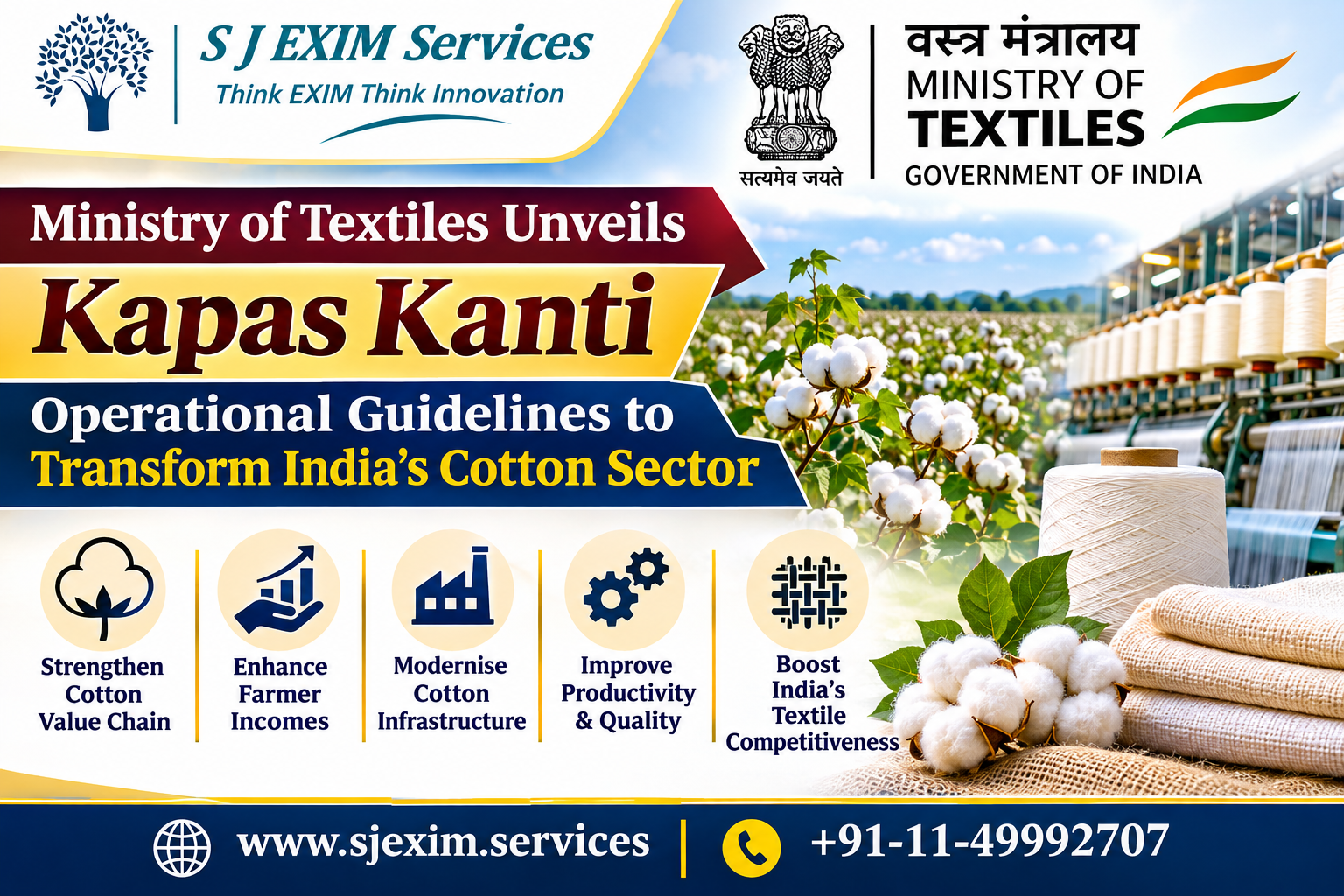
Ministry of Textiles Unveils Kapas Kanti Operational Guidelines to Transform India’s Cotton Sector
India’s Mission for Cotton Productivity, known as Kapas Kanti, is a five-year national programme designed to improve cotton yields, quality, traceability, market access and farmer incomes across the value chain.
Cotton is central to India’s agricultural and textile economy. India produces more than 21% of the world’s cotton and cultivates the crop on about 114.47 lakh hectares, supporting over six million farmers. Yet average productivity remains around 440 kg per hectare, constrained by rain-fed cultivation, pest pressure, climate volatility, contamination, uneven quality practices and limited mechanization.
Announced in the 2025 Union Budget and approved by the Union Cabinet in May 2026, the Mission brings a farm-to-market approach under the national 5F vision: Farm to Fibre to Factory to Fashion to Foreign. Its total outlay is ₹5,659.22 crore, with ₹1,000 crore allocated to Component II: Quality Improvement and Branding, implemented by the Ministry of Textiles through the Cotton Corporation of India (CCI).
Why the Mission Matters
India is already a major cotton producer, but scale alone does not ensure premium value. The sector faces persistent barriers:
- Low and uneven productivity: About 67% of cotton cultivation is rain-fed, and adoption of scientific practices such as high-density planting remains uneven.
- Pest and climate risks: Pink bollworm resistance, droughts, erratic rainfall and soil degradation undermine yield reliability.
- Quality losses: Foreign matter, poor picking and storage practices, varietal mixing, and aging ginning infrastructure reduce fibre quality and export competitiveness.
- Gaps in testing and traceability: Global buyers increasingly expect evidence of origin, quality and sustainability throughout the supply chain.
- Labour and processing constraints: Rising labour costs and limited mechanization affect harvesting, while inconsistent ginning practices affect bale quality.
Kapas Kanti addresses these problems as interconnected challenges. Better seeds and farm practices can lift output, but higher farmer returns also require cleaner cotton, reliable testing, credible certification, transparent market access and stronger demand for Indian cotton brands.
Three Components, One Value-Chain Strategy
The Mission combines productivity improvement, quality upgrading and fibre diversification.
1. Productivity Enhancement
Implemented through agricultural and research institutions, the first component focuses on climate-resilient and pest-resistant varieties, high-yielding hybrids, precision farming, mechanization and farmer access to modern production practices. It aims to raise India’s cotton productivity to 755 kg per hectare by 2031.
2. Quality Improvement and Branding
Component II strengthens the commercial value of Indian cotton by promoting premium, low-contamination bales; supporting Kasturi Cotton Bharat; expanding testing and certification; improving digital market access; building skills in ginning factories; supporting innovation; and encouraging cotton-waste recycling.
3. Fibre Diversification Through New-Age Fibres
The third component supports fibres such as flax, hemp, banana, pineapple leaf fibre, bamboo, ramie, sisal, kapok and nettle. Through cultivation support, rural processing, innovation and market development, it seeks to create sustainable fibre ecosystems and value-added blends with cotton.
Kasturi Cotton Bharat: Building a Premium Indian Cotton Brand
At the centre of Component II is Kasturi Cotton Bharat (KCB), India’s premium cotton programme. It is designed to position Indian cotton as a globally recognized product associated with superior fibre quality, end-to-end traceability and sustainability.
Kasturi Cotton Bharat is assessed against key fibre parameters, including staple length, micronaire, reflectance, strength, uniformity, trash and moisture. Certified bales are backed by sampling, testing and certification systems, while the KC Track blockchain and QR-code platform is intended to provide traceability from farm to finished product.
For textile businesses, this means more reliable cotton specifications, reduced waste, higher operational efficiency and support for buyer expectations around origin and sustainability. For consumers, the programme emphasizes softer, stronger, more durable and visually appealing cotton products. For farmers, improved picking, segregation and storage practices can help unlock better price realization.
Output-Based Support for Ginning and Pressing Factories
To scale certified cotton production, eligible Ginning and Pressing (G&P) factories can receive ₹500 per certified Kasturi Cotton Bharat bale, subject to a cumulative cap of ₹75 lakh per factory during the Mission period.
The programme has a target of 133 lakh certified Kasturi Cotton Bharat bales from FY 2026–27 to FY 2030–31. Factories must be registered under the certification programme, hold at least a three-star rating under the Textiles Committee’s rating system, and install an Air Jet Lint Cleaner.
Support is structured to reinforce both quality and market realization:
- 50% of an eligible claim is released after bale certification.
- The remaining 50% is released after sale and submission of a Transaction Certificate, or proof of captive consumption where applicable.
- Claims are processed through direct benefit transfer, subject to complete and compliant documentation.
This structure encourages factories not only to produce certified bales, but also to complete traceable market transactions.
Reducing Contamination at the Farm Level
Contamination directly weakens fibre quality, spinning efficiency and market value. The Contamination Controlled Cotton sub-component addresses this problem at its source: harvesting, handling, storage and transport.
The programme will support at least 2 lakh cotton farmers during the Mission period. It is implemented as a Centrally Sponsored Scheme, with funding shared 60:40 between the Central and State Governments. The Central share is capped at ₹3,000 per farmer.
Eligible farmers are selected by State Governments from those covered under the Mission’s farm-level productivity component, with priority for Scheduled Caste and Scheduled Tribe beneficiaries, small and marginal farmers including women farmers, farmers in Kasturi villages, and eligible Forest Rights Act patta holders.
What the Contamination-Control Kit Includes
The recommended kit includes practical tools for contamination-free cotton handling:
- Cotton picking apron or bag
- Cotton collection bag
- Reusable cotton storage cloth
- Cotton head cover
- Seamless latex-coated gloves
The cotton fabric components are designed to avoid synthetic fibres, coloured fibres, plastic fragments, jute particles, oil stains and loose yarns. Alongside distribution, States are expected to conduct farmer awareness and capacity-building programmes on clean picking, storage, handling and reduced plastic contamination.
Digital Platforms for Transparency and Better Market Access
Kapas Kanti places digital infrastructure at the heart of implementation.
Kasturi Cotton e-Portal
A dedicated e-portal will facilitate listing and e-auctions of Kasturi Cotton Bharat bales. Its role is limited to neutral market facilitation and transparent price discovery: buyers and sellers conclude transactions, payments and dispute resolution directly with each other.
The platform is expected to support:
- Buyer and seller registration
- Bale listing and e-auction
- Transparent price discovery
- Traceability information
- Notifications, audit trails and reporting
- User support and helpdesk services
Over time, the platform may be expanded to support other cotton categories as well.
Farmers e-Data Platform
A separate platform will help States digitize farmer records and integrate them with Agricultural Produce Market Committees (APMCs). The goal is to create a reliable national cotton farmer database and improve transparency in cotton transactions and procurement.
Key features include unique Farmer IDs, land-record integration, data validation, APMC transaction software, digital auction and weighment slips, invoices, optional Aadhaar-based authentication, and integration with payment systems for direct benefit transfers during MSP procurement.
Stronger Testing, Certification and Processing Capacity
A premium cotton ecosystem needs credible quality verification. The Mission plans to establish 50 Cotton Testing Laboratories near major cotton-producing areas, with an indicative assistance of ₹60 lakh per laboratory.
The labs are expected to use standardized equipment such as High Volume Instruments, trash analyzers and conditioning chambers. They will be required to follow recognized testing protocols, maintain equipment calibration, deploy trained personnel and obtain NABL accreditation within the stipulated timeframe.
The Mission also plans to train 10,000 workers across 2,000 registered Ginning and Pressing factories. Managers, supervisors, graders and ginning fitters will receive training on best management practices, quality control and modern processing techniques. Training may be delivered through physical sessions as well as digital learning platforms.
Innovation, Data and Circularity
Kapas Kanti recognizes that cotton-sector transformation depends on more than conventional production practices.
Scientific Demand and Supply Assessment
The Office of the Textile Commissioner will use remote sensing, satellite imagery, field validation and AI/ML-based models to improve estimates of crop acreage, crop health, yield, production and demand. A centralized dashboard is envisioned to make cotton-market information more timely and useful for policy and market decisions.
Support for Startups and New Solutions
The programme provides support of up to ₹50 lakh per startup for solutions that improve productivity, quality, traceability, harvesting, waste recycling or supply-chain efficiency. It envisages innovation challenges, hackathons, pilot deployments and scale-up support for promising technologies.
Cotton Waste Recycling
To advance a circular economy, the Mission supports collection, segregation, recovery and recycling of cotton and textile waste. Three pilot Textile Recovery Facilities are proposed across the northern, central/western and southern textile regions. These facilities will help organize waste collection, baling, storage and channelization for recycling and value addition.
Expected Impact by 2031
The Mission’s intended outcomes are clear: more productive farms, cleaner fibre, better processing, stronger market confidence and higher value across the cotton chain.
- Higher productivity: Cotton yield is targeted to rise to 755 kg per hectare by 2031.
- Better quality: Reducing contamination to below 2% can strengthen export potential and improve suitability for premium textile production.
- Improved farmer incomes: Higher yields, cleaner cotton and stronger market linkages are intended to improve price realization.
- Greater global competitiveness: Testing, certification, traceability and branding can help Indian cotton meet buyer expectations in domestic and international markets.
- More sustainable growth: Climate-resilient practices, quality-focused farm handling and recycling initiatives support a more resource-efficient cotton sector.
A Shift From Commodity Cotton to Trusted Cotton
Kapas Kanti is designed to move India’s cotton sector beyond volume-led growth. Its long-term proposition is that cotton becomes more valuable when the entire value chain can demonstrate quality, cleanliness, origin, consistency and responsible production.
By connecting farm practices with ginning upgrades, laboratory testing, digital traceability, transparent market access, premium branding and recycling, the Mission creates a pathway for Indian cotton to compete not only on scale, but also on trust and value.
In case you face any issues related to Indirect Tax-Customs, GST, Foreign Trade Policy (FTP), Arbitration matters and Central Licensing and related advisory matters in India then please feel free to get in touch with SJ EXIM Services.
We offer Legal advice and litigation support in matters related to Indirect Tax-Customs, FTP, other Indirect Tax matters & Arbitration law, all sorts of Central licensing and related matters. Come and explore the new way of doing business with us!
We specialize in paralegal services, litigation support, tax and regulatory matters, delivering reliable, efficient, and result-oriented legal assistance.
Source: Ministry of Textiles
Handy Download:
Connect with us for more-
@ Team S J EXIM SERVICES, New Delhi, IN
CP: Ms. Shubhra Jha, Founder
Tel: +91-11-4999 2707 I +91-9999005693
Web: www.sjexim.services
EMAIL: operations@sjexim.services I shubhra@sjexim.services
Facebook: www.facebook.com/sjeximservices
LinkedIn: https://www.linkedin.com/company/90794255/admin/feed/posts/
YouTube: https://youtube.com/@tradechaupaal
Subscribe our WhatsApp Channel: https://whatsapp.com/channel/0029VaTxDT8JZg4CHEOSoK47
Subscribe our Telegram Channel: https://t.me/sjeximindia



Leave a Reply