

“Indirect Tax I Indirect Tax Litigation I Customs & FTP I Central Licensing I Arbitration I Advisory”
Dated: 21.11.2026
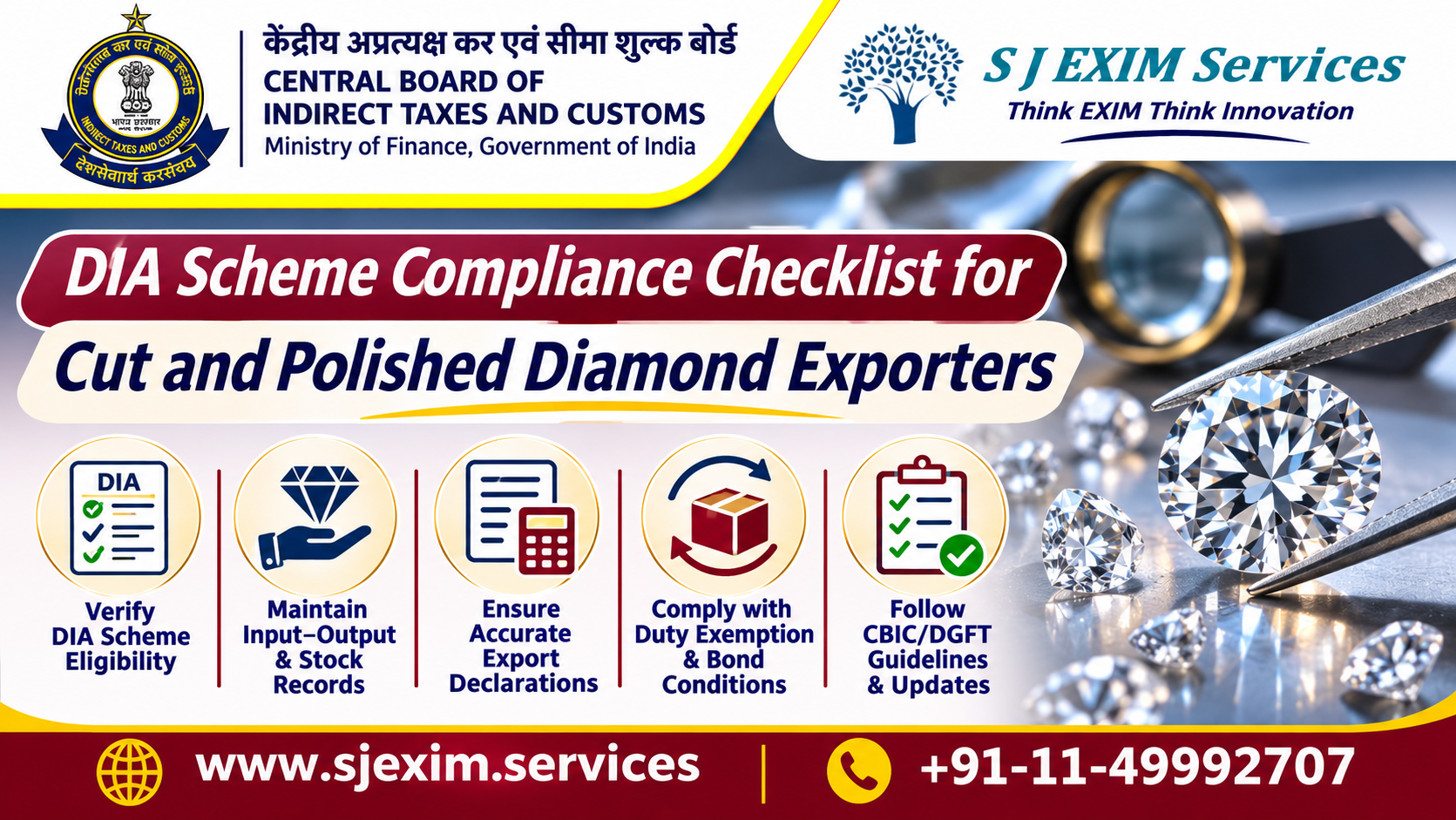
DIA Scheme Compliance Checklist for Cut and Polished Diamond Exporters
The Diamond Imprest Authorisation (DIA) Scheme allows eligible diamond exporters to import specified natural diamonds duty-free, provided they meet strict export, value-addition, recordkeeping, and actual-user requirements.
What is the DIA Scheme?
Introduced by the Directorate General of Foreign Trade and implemented through Customs Notification No. 37/2026-Customs, the DIA Scheme is designed to support exporters of natural cut and polished diamonds. It permits qualifying businesses to import eligible diamonds for processing and subsequent physical export.
The customs-duty exemption is conditional. Businesses must comply with the authorisation terms, including the required export obligation and all applicable Foreign Trade Policy and Customs procedures.
Eligible Diamond Imports
The scheme covers imports of natural cut and polished diamonds, including:
- Semi-processed diamonds
- Half-cut diamonds
- Broken diamonds
Each imported diamond must weigh no more than 1/4 carat, or 25 cents.
Laboratory-grown diamonds are expressly excluded from the exemption. The scheme is therefore limited to eligible natural diamonds.
Who Can Apply?
To access DIA benefits, an importer must meet all of the following eligibility conditions:
- Hold Two-Star Export House status or higher under the Foreign Trade Policy.
- Have achieved at least US$15 million in exports of cut and polished diamonds in each of the preceding three financial years.
- Have filed all required GST returns and income-tax returns for the preceding three years.
- If the previous year’s income-tax return has not yet been finalised, submit a Chartered Accountant certificate confirming that evidence of filing will be provided by 31 December of the application year.
Only one DIA authorisation per Importer Exporter Code (IEC) is permitted in a financial year.
Import Limit and Authorisation Validity
The DIA Scheme allows imports up to 5% of the exporter’s average annual export performance during the previous three years, subject to a maximum cap of US$15 million.
The import authorisation remains valid for 12 months from its date of issue. Importers should therefore plan their sourcing and clearance activity within this period.
Export Obligation and Value Addition Requirement
A DIA holder must fulfil an export obligation within 18 months from the authorisation date. No extension is available for this obligation.
The exporter must achieve at least 10% value addition and realise export proceeds in free foreign exchange. Only exports made after the DIA imports are eligible to discharge this obligation.
To establish the link between imports and exports, the relevant shipping bills must:
- Carry the applicable DIA Scheme Code; and
- Be endorsed with the DIA number.
This sequencing requirement is important: exports completed before the DIA import cannot be counted toward the authorisation’s export obligation.
Where Imports and Exports Must Be Cleared
All DIA-related imports and exports must be routed through Mumbai Airport. Customs-clearance procedures are handled, as applicable, through the Precious Cargo Customs Clearance Centre at Bharat Diamond Bourse, Bandra Kurla Complex, Mumbai.
This centralised routing requirement helps Customs maintain oversight of eligible goods and corresponding export transactions.
Actual User, Pre-Import and Non-Transferability Conditions
The authorisation and the imported diamonds are subject to pre-import and actual-user conditions. In practice, this means the DIA holder must import the goods before claiming corresponding export fulfilment and must use the diamonds for the authorised purpose.
The imported goods cannot be sold or transferred to another party, even after the export obligation has been fulfilled.
The diamonds may be used:
- At any unit of the DIA holder, subject to the applicable Handbook of Procedures conditions; or
- By an authorised job worker or supporting manufacturer, if this arrangement is endorsed on the authorisation by the Regional Authority.
A co-licensee facility is not available under the DIA Scheme.
Bond, Bank Guarantee and Compliance Records
Before availing duty exemption, the importer must execute:
- A bond equal to the export obligation specified in the DIA; and
- A bank guarantee equal to the customs duty forgone.
The Single All-India Multipurpose electronic Bond and e-Bank Guarantee framework may be used for this purpose.
Importers must also maintain detailed, inspection-ready records for every import and export lot. These records should include:
- Diamond size in carats
- Colour
- Clarity
- Cut
- Lot value
- Corresponding bill of entry for imports
- Corresponding shipping bill for exports
Accurate lot-level records are essential because Customs may inspect them to verify the authorised use of imports and the fulfilment of export obligations.
What Happens if the Export Obligation Is Not Met?
For a bona fide default, the authorisation holder must pay customs duty on the unutilised value of the imported materials, along with applicable interest under Section 28AA of the Customs Act, 1962.
Payment must be made through the Voluntary/Self-Initiated Payment facility on the ICEGATE e-Payment Platform. This mechanism enables importers to regularise a shortfall, but it does not remove the financial consequences of non-compliance.
Key Takeaway for Diamond Exporters
The DIA Scheme can provide a significant duty benefit for established natural-diamond exporters with a strong compliance record and consistent export performance.
Its value depends on disciplined execution: imports must be routed through the prescribed Mumbai channel, goods must remain with the authorised user, exports must follow imports, and the 10% value-addition obligation must be completed within the non-extendable 18-month period.
For eligible exporters, the scheme offers a structured route to secure imported natural diamonds while supporting export-oriented processing and trade.
In case you face any issues related to Indirect Tax-Customs, GST, Foreign Trade Policy (FTP), Arbitration matters and Central Licensing and related advisory matters in India then please feel free to get in touch with SJ EXIM Services.
We offer Legal advice and litigation support in matters related to Indirect Tax-Customs, FTP, other Indirect Tax matters & Arbitration law, all sorts of Central licensing and related matters. Come and explore the new way of doing business with us!
We specialize in paralegal services, litigation support, tax and regulatory matters, delivering reliable, efficient, and result-oriented legal assistance.
Source: CBIC, Ministry of Finance, Govt. of India
Handy Download:
Connect with us for more-
@ Team S J EXIM SERVICES, New Delhi, IN
CP: Ms. Shubhra Jha, Founder
Tel: +91-11-4999 2707 I +91-9999005693
Web: www.sjexim.services
EMAIL: operations@sjexim.services I shubhra@sjexim.services
Facebook: www.facebook.com/sjeximservices
LinkedIn: https://www.linkedin.com/company/90794255/admin/feed/posts/
YouTube: https://youtube.com/@tradechaupaal
Subscribe our WhatsApp Channel: https://whatsapp.com/channel/0029VaTxDT8JZg4CHEOSoK47
Subscribe our Telegram Channel: https://t.me/sjeximindia



Leave a Reply