

“Indirect Tax I Indirect Tax Litigation I Customs & FTP I Central Licensing I Arbitration I Advisory”
Dated: 11.08.2026
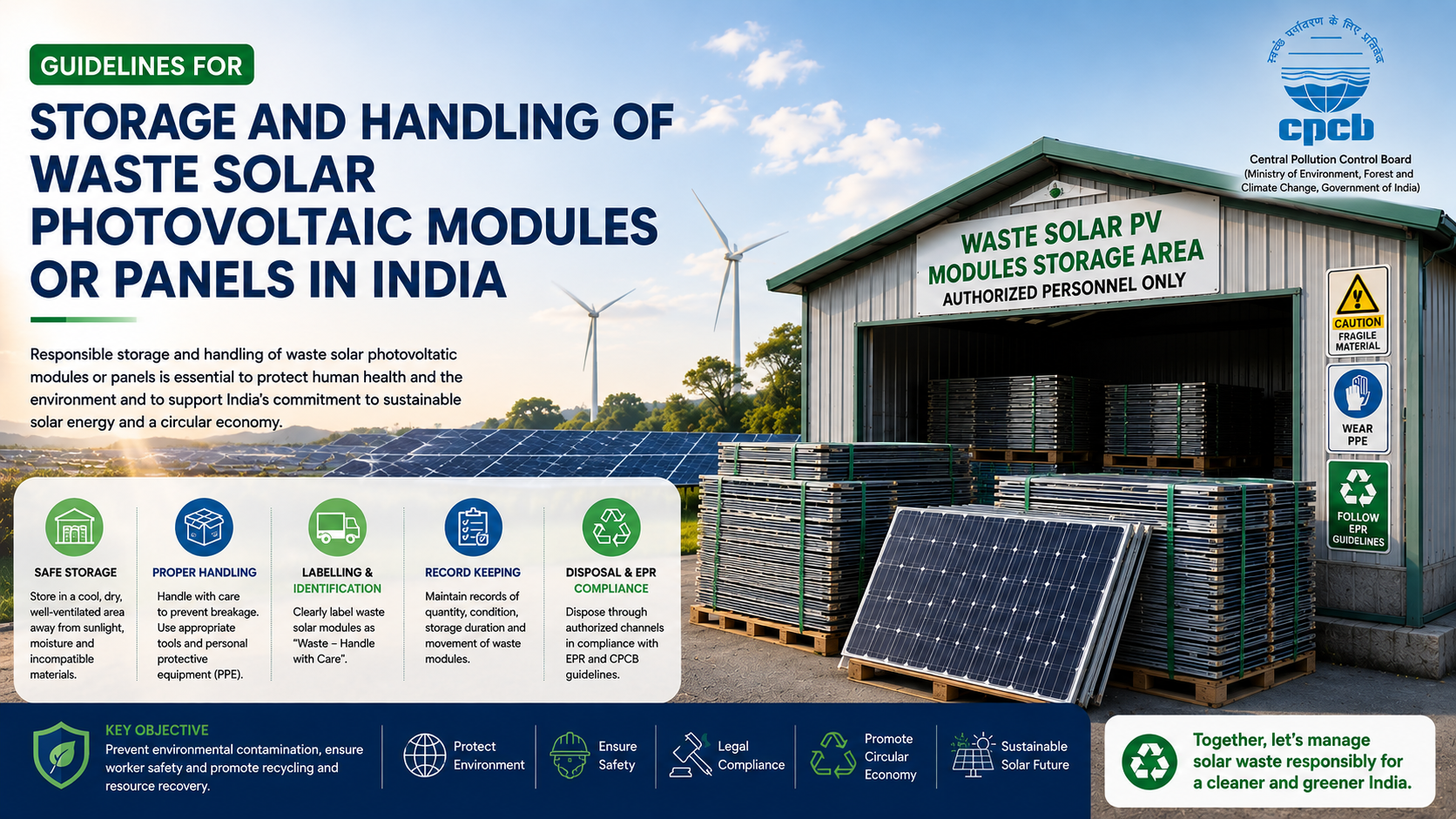
Guidelines for Storage and Handling of Waste Solar Photovoltaic Modules or Panels in India
India’s rapid adoption of solar energy has brought significant environmental benefits, but it also introduces new challenges in managing end-of-life solar photovoltaic (PV) modules, panels, and cells. The E-Waste (Management) Rules, 2022, and the Central Pollution Control Board’s (CPCB) guidelines provide a comprehensive framework to ensure the safe, environmentally sound storage, handling, and transportation of solar waste.
Background: Regulatory Framework
The E-Waste (Management) Rules, 2022, effective from April 1, 2023, regulate the management of waste electrical and electronic equipment (EEE), including solar PV modules, panels, and cells. These rules aim to protect human health and the environment from the adverse effects of e-waste. Solar PV waste is categorized under CEEW 14 and is subject to specific compliance requirements for producers, manufacturers, and recyclers.
Scope and Objectives
The guidelines are designed to:
- Provide technical direction for the transport, handling, and storage of waste solar PV modules, panels, and cells (collectively referred to as “Solar Waste”).
- Ensure that all activities are conducted in a manner that protects health and the environment.
- Apply to all producers, manufacturers, and recyclers involved in the solar PV sector.
Environmental Concerns
While solar energy is a cornerstone of sustainable development, improper management of end-of-life solar panels can lead to environmental and health risks. Toxic substances such as lead, cadmium, and arsenic may leach into soil and groundwater if solar waste is not managed properly.
Composition of Solar Panels
Solar panels typically consist of:
- Glass
- Aluminum frame
- Silicon wafers
- Metals (copper, silver, lead, cadmium, tellurium, gallium, arsenic, tin, etc.)
- Plastics
Both recyclable and non-recyclable materials are present, making proper segregation and recycling essential.
Guidelines for Transportation, Handling, and Storage
Transportation
- No Open Disposal: Solar waste must not be dumped in open areas or landfills to prevent toxic chemical release.
- Registered Recyclers: Only registered recyclers should receive solar waste for recycling. For collection and storage, waste may be handed to registered producers or manufacturers.
- Collection Mechanism: Producers and manufacturers must establish and publicize collection systems, including take-back schemes and collection points.
- Consumer Information: Provide consumers with:
- Website links for collection/take-back information
- Contact details for queries and grievances
- Details of collection points, pick-up vans, and authorized recycling facilities
- Maintain a database of consumers for efficient collection
- Covered Transport: Use covered trucks for transportation.
- Hazardous Waste Compliance: Follow the Hazardous and Other Wastes (Management and Transboundary Movement) Rules, 2016, for final disposal transport.
Storage and Handling
- Prevent Breakage: Store solar waste to avoid breakage and ensure worker safety.
- Avoid Damage: Prevent contact with sharp objects and collisions.
- Maintain Reusability: Store waste to preserve potential for reuse, refurbishing, or recycling.
- Covered, Dry, and Ventilated Storage: Use covered sheds or spaces, ensuring a dry and well-ventilated environment.
- Non-Leachable Floors: Storage floors must be impervious and non-leachable to prevent soil and groundwater contamination.
- Separate Broken Waste: Store broken or disintegrated panels in rigid, water-resistant containers with clear labeling.
- Stable Stacking: Do not stack waste higher than safe mechanical stability allows.
- Fire Safety: Equip storage areas with fire protection systems, emergency exits, and an emergency response plan.
- Incident Reporting: Report any fire incidents to local authorities.
- Clear Labeling: Label storage racks and containers for easy identification and sorting.
- Inventory Management: Regularly update and maintain records of stored solar waste.
- Monthly Inspections: Inspect storage areas monthly and record findings using the prescribed format.
- Personal Protective Equipment (PPE): Provide all handlers with gloves, safety footwear, eye protection, and respirators as needed.
Inspection and Record-Keeping
A monthly inspection report must be maintained, covering:
- Condition of storage area floor
- Availability of covered sheds
- Adequate ventilation and lighting
- Proper segregation and labeling
- Fire safety equipment
- Spill control kits and PPE
- Updated storage inventory
- Any incidents of damage, spillage, or leakage
Conclusion
Proper storage and handling of waste solar PV modules, panels, and cells are critical for environmental protection and regulatory compliance. By following these guidelines, stakeholders can ensure the safe management of solar waste, supporting India’s commitment to sustainable energy and environmental stewardship.
In case you face any issues related to Indirect Tax-Customs, GST, Foreign Trade Policy (FTP), Arbitration matters and Central Licensing and related advisory matters in India then please feel free to get in touch with SJ EXIM Services.
We offer Legal advice and litigation support in matters related to Indirect Tax-Customs, FTP, other Indirect Tax matters & Arbitration law, all sorts of Central licensing and related matters. Come and explore the new way of doing business with us!
We specialize in paralegal services, litigation support, tax and regulatory matters, delivering reliable, efficient, and result-oriented legal assistance.
Source: CPCB, Ministry of Environment, Forests & Climate Change
Handy Download:
Connect with us for more-
@ Team S J EXIM SERVICES, New Delhi, IN
CP: Ms. Shubhra Jha, Founder
Tel: +91-11-4999 2707 I +91-9999005693
Web: www.sjexim.services
EMAIL: operations@sjexim.services I shubhra@sjexim.services
Facebook: www.facebook.com/sjeximservices
LinkedIn: https://www.linkedin.com/company/90794255/admin/feed/posts/
YouTube: https://www.youtube.com/@aadrikaalawindia
Subscribe our WhatsApp Channel: https://whatsapp.com/channel/0029VaTxDT8JZg4CHEOSoK47
Subscribe our Telegram Channel: https://t.me/sjeximindia






Leave a Reply