

“Indirect Tax I Indirect Tax Litigation I Customs & FTP I Central Licensing I Arbitration I Advisory”
Dated: 18.09.2026
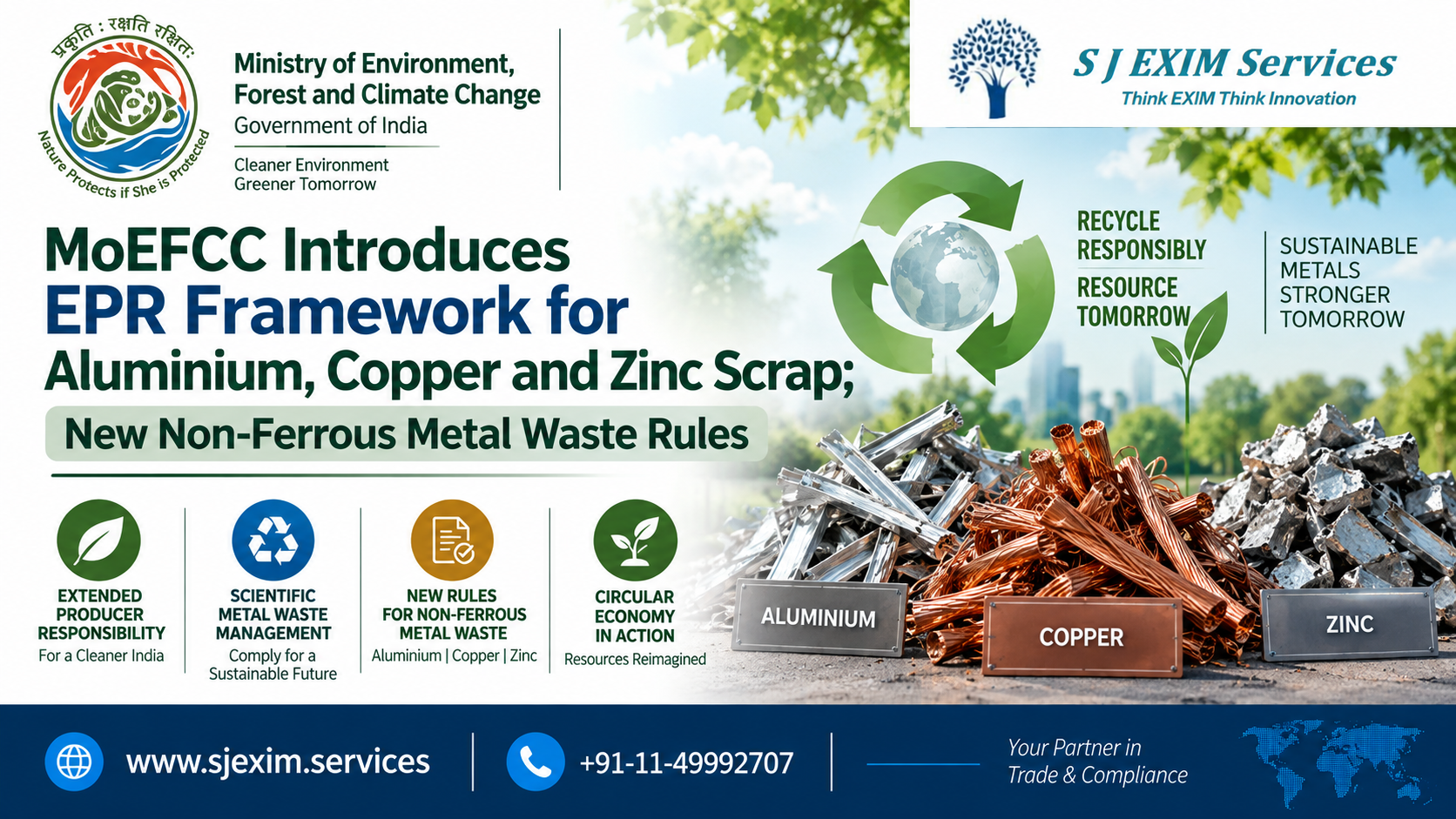
MoEFCC Introduces EPR Framework for Aluminium, Copper and Zinc Scrap; New Non-Ferrous Metal Waste Rules
The Ministry of Environment, Forest and Climate Change (MoEFCC) has notified a comprehensive Extended Producer Responsibility (EPR) framework for scrap of non-ferrous metals, bringing products made from aluminium, copper, zinc and their alloys within a new recycling, registration and compliance regime.
The Hazardous and Other Wastes (Management and Transboundary Movement) Amendment Rules, 2025, notified through G.S.R. 438(E) dated July 1, 2025, amend the Hazardous and Other Wastes (Management and Transboundary Movement) Rules, 2016 and will come into force from April 1, 2026. The notification has been issued by the Central Government under Sections 6, 8 and 25 of the Environment (Protection) Act, 1986.
The new framework inserts Chapter VIII – “Extended Producer Responsibility for Scrap of Non-Ferrous Metals” into the 2016 Rules and creates obligations for manufacturers, producers, importers, collection agents, refurbishers, recyclers and bulk consumers.
Aluminium, Copper and Zinc Brought Under EPR Regime
- For purposes of the new Chapter, “non-ferrous metals” specifically means aluminium, copper, zinc or their alloys.
- Significantly, the definition of “producer” is broad. It covers entities manufacturing and selling non-ferrous metal products under their own brand, brand owners selling products manufactured by others, entities selling imported non-ferrous metal products under their own or original brand, and persons who import used devices, products or scrap of non-ferrous metals.
- Accordingly, the new framework is not confined to domestic metal manufacturers. Importers and brand owners dealing in covered products can also come within the EPR regime.
Mandatory CPCB Registration
- One of the most important compliance changes is mandatory registration on the Central Pollution Control Board (CPCB) portal.
- Rule 45 requires registration of five categories of entities: manufacturers, producers, collection agents, refurbishers and recyclers. Where an entity falls within more than one category, it must obtain separate registration under each applicable category.
- More importantly, a covered entity cannot carry on business without registration, and registered entities are prohibited from dealing with another covered entity that is not registered.
- This creates a compliance chain across the non-ferrous metal ecosystem rather than imposing obligations only at the producer level.
EPR Recycling Targets Start at 10% and Rise to 75%
- The centrepiece of the new regime is the recycling obligation imposed upon producers.
- Under Rule 46, every producer is responsible for recycling non-ferrous metal scrap arising from products listed in Schedule X and must meet the EPR targets specified in Schedule XI. A producer may use collection agents or dealers, but the Rules expressly provide that the ultimate responsibility for fulfilling the EPR target remains with the producer.
Schedule XI introduces progressively increasing recycling targets:
| Financial Year | Recycling Target |
| 2026-27 | 10% |
| 2027-28 | 10% |
| 2028-29 | 30% |
| 2029-30 | 30% |
| 2030-31 | 50% |
| 2031-32 | 50% |
| 2032-33 onwards | 75% |
- The percentage is calculated by weight with reference to the quantity of non-ferrous metal products in year Y-X, where “X” represents the average life of the relevant product. CPCB is to specify the average life of products made from aluminium, copper, zinc or their alloys.
- For units established after April 1, 2026, the EPR obligation begins after two years. The Rules also provide that the recycling targets may be reviewed and increased after the end of 2033-34.
100% EPR Obligation for Importers of Used Products and Non-Ferrous Scrap
- A particularly significant provision applies to importers.
- Schedule XI states that the EPR obligation for importers of used devices, used products or scrap of non-ferrous metals in year Y will be 100% of the non-ferrous metals imported in the preceding year (Y-1).
- This is substantially different from the phased 10%-30%-50%-75% targets applicable under the general producer framework and is therefore likely to be particularly relevant to businesses importing aluminium, copper or zinc scrap and used products.
EPR Certificates Can Be Purchased From Registered Recyclers
- The Rules introduce a certificate-based compliance mechanism.
- A producer may meet its EPR target by purchasing EPR certificates from registered recyclers through the online portal. Rule 47 provides for CPCB to generate certificates in favour of registered recyclers based on eligible recycling output.
The certificate quantity is calculated using the formula:
QEPR = Qp × Cf
- where QEPR is the quantity eligible for certificate generation, Qp is the quantity of the end product and Cf represents the applicable conversion factor.
- EPR certificates will remain valid for two years from the end of the financial year in which they are generated.
EPR Certificate Trading to Operate Through Online System
- The framework also contemplates an organised market for EPR certificates.
- Transactions relating to EPR certificates, refurbishment certificates and compliance are to be recorded through the portal. CPCB is also empowered to determine a floor and ceiling price for exchange of EPR certificates, linked to environmental compensation for failure to meet EPR obligations.
- The Rules therefore create not merely a recycling obligation but a digital certificate-based compliance architecture for non-ferrous metal scrap.
CPCB Portal to Become Central Compliance Platform
- Under Rule 50, CPCB is required to establish an online system for registration, filing of half-yearly and annual returns, fulfilment of EPR obligations, certificate transactions and sharing of relevant information.
- The portal will function as a single-point data repository for implementation of the non-ferrous metal scrap EPR framework.
- The Rules require CPCB to make the portal functional within six months from the date of commencement of the 2025 Amendment Rules, and EPR implementation activities are to be conducted online.
Manufacturers Face Separate Recycled-Content Obligation
- The Rules go beyond end-of-life recycling and impose a separate obligation on manufacturers to incorporate domestically recycled material into new products.
- Rule 51 requires manufacturers to comply with the minimum recycled-content requirements prescribed in Schedule XIII.
The minimum recycled content is:
| Metal | 2028-29 | 2029-30 | 2030-31 | 2031-32 |
| Aluminium | 5% | 10% | 10% | 10% |
| Copper | 5% | 10% | 15% | 20% |
| Zinc | 5% | 10% | 15% | 25% |
The percentages are calculated with reference to the total quantity of the relevant non-ferrous metal used in manufacturing the product.
The Rules, however, permit CPCB to grant exemption on a case-by-case basis where use of recycled material is not possible because of a statutory or technical requirement.
Which Products Are Covered?
- Schedule X identifies 18 categories of products made from non-ferrous metals. The coverage extends across packaging, construction, electrical, industrial and consumer applications.
- The listed products include cans used for beverages and aerosols; packaging foils for food and pharmaceutical products; doors, windows and shutters; aluminium composite panels; aluminium partitions and grills; utensils; furniture and hardware; roofing and ceiling sheets; motors, pumps and alternators; conductor cables, wires and strips; sanitary ware; electrical fittings; aluminium-alloy bicycles; transformers; electric generator sets; centralised air-conditioning plants; apparel products such as belt buckles, zips and shoes; and toys.
- The Schedule specifically excludes automobile-grade products in certain categories, including motors/pumps/alternators, conductor cables and wires, electrical fittings and transformers.
Separate Responsibilities for Producers, Recyclers and Bulk Consumers
- The notification creates entity-specific responsibilities throughout the supply chain.
- Producers must register, file prescribed returns, undertake awareness activities and ensure environmentally sound collection and transportation of scrap. Collection agents must collect end-of-life scrap and channel it to registered recyclers. Recyclers must maintain records of scrap received and quantities recycled, unrecycled or disposed of, while also ensuring environmentally sound storage, transportation and processing.
- A bulk consumer is defined as an entity using at least 1,000 tonnes of products listed in Schedule X at any point during a particular financial year. Such consumers must facilitate collection by establishing collection points and ensure that their generated scrap is handed over only to registered recyclers, refurbishers, producers or collection agents.
Half-Yearly and Annual Returns
- The framework also establishes recurring reporting obligations.
- Manufacturers, producers, collection agents, refurbishers and recyclers are required to file half-yearly returns by October 31 and annual returns by June 30 following the relevant financial year, subject to the prescribed portal formats.
- This means affected businesses will need systems capable of tracking quantities manufactured, imported, collected, refurbished, recycled and transferred through the compliance chain.
BIS Given New Responsibility Under the EPR Rules
- An important feature of the notification is the role assigned to the Bureau of Indian Standards (BIS).
- Rule 59 requires BIS to revise existing standards and issue necessary standards relating to these Rules within six months from their commencement.
- This provision creates an important interface between environmental compliance, recycled-content requirements and product-quality standards for industries using aluminium, copper and zinc.
Environmental Compensation and Enforcement
- The Rules provide for environmental compensation where a manufacturer, producer, collection agent, refurbisher or recycler—whether registered or unregistered—fails to comply and causes loss, damage or injury to the environment or public health.
- Payment of environmental compensation does not extinguish the underlying EPR obligation. An unfulfilled target may be carried forward for up to three years.
- Where subsequent compliance occurs, portions of environmental compensation may be returned: 85% for compliance within one year, 60% within two years and 30% within three years. After three years, no refund is available.
- The Rules additionally provide that non-compliance may attract action under Section 15 of the Environment (Protection) Act, 1986, while CPCB may conduct inspections and periodic audits.
What Businesses Should Prepare for Before April 1, 2026
- The new regime represents a major compliance development for businesses dealing in aluminium, copper, zinc and their alloys. Companies should first determine whether their products fall within Schedule X and then identify whether their activities make them a manufacturer, producer/importer, collection agent, refurbisher, recycler or bulk consumer.
- Particular attention will be required for imported products and scrap because the definition of producer expressly includes specified import activities, while Schedule XI separately imposes the 100% preceding-year EPR formula on importers of used devices, products or non-ferrous metal scrap.
- Businesses should also prepare product-wise quantity records, supply-chain traceability, arrangements with registered recyclers, return-filing systems and recycled-content sourcing mechanisms where applicable.
Key Takeaway
The Hazardous and Other Wastes (Management and Transboundary Movement) Amendment Rules, 2025 establish India’s dedicated EPR regime for scrap arising from covered aluminium, copper, zinc and alloy products.
Effective April 1, 2026, the framework combines mandatory CPCB registration, progressively increasing recycling targets, EPR certificate trading, reporting obligations, minimum recycled-content requirements, audit and environmental-compensation provisions.
For importers, one of the most consequential provisions is the 100% EPR obligation for used devices, used products and non-ferrous metal scrap based on the preceding year’s imports. For manufacturers, the next major milestone arrives in 2028-29, when minimum recycled-content requirements begin.
In case you face any issues related to Indirect Tax-Customs, GST, Foreign Trade Policy (FTP), Arbitration matters and Central Licensing and related advisory matters in India then please feel free to get in touch with SJ EXIM Services.
We offer Legal advice and litigation support in matters related to Indirect Tax-Customs, FTP, other Indirect Tax matters & Arbitration law, all sorts of Central licensing and related matters. Come and explore the new way of doing business with us!
We specialize in paralegal services, litigation support, tax and regulatory matters, delivering reliable, efficient, and result-oriented legal assistance.
Source: MoEFCC
Handy Download:
Connect with us for more-
@ Team S J EXIM SERVICES, New Delhi, IN
CP: Ms. Shubhra Jha, Founder
Tel: +91-11-4999 2707 I +91-9999005693
Web: www.sjexim.services
EMAIL: operations@sjexim.services I shubhra@sjexim.services
Facebook: www.facebook.com/sjeximservices
LinkedIn: https://www.linkedin.com/company/90794255/admin/feed/posts/
YouTube: https://www.youtube.com/@aadrikaalawindia
Subscribe our WhatsApp Channel: https://whatsapp.com/channel/0029VaTxDT8JZg4CHEOSoK47
Subscribe our Telegram Channel: https://t.me/sjeximindia




Leave a Reply