

“Indirect Tax I Indirect Tax Litigation I Customs & FTP I Central Licensing I Arbitration I Advisory”
Dated: 06.10.2026
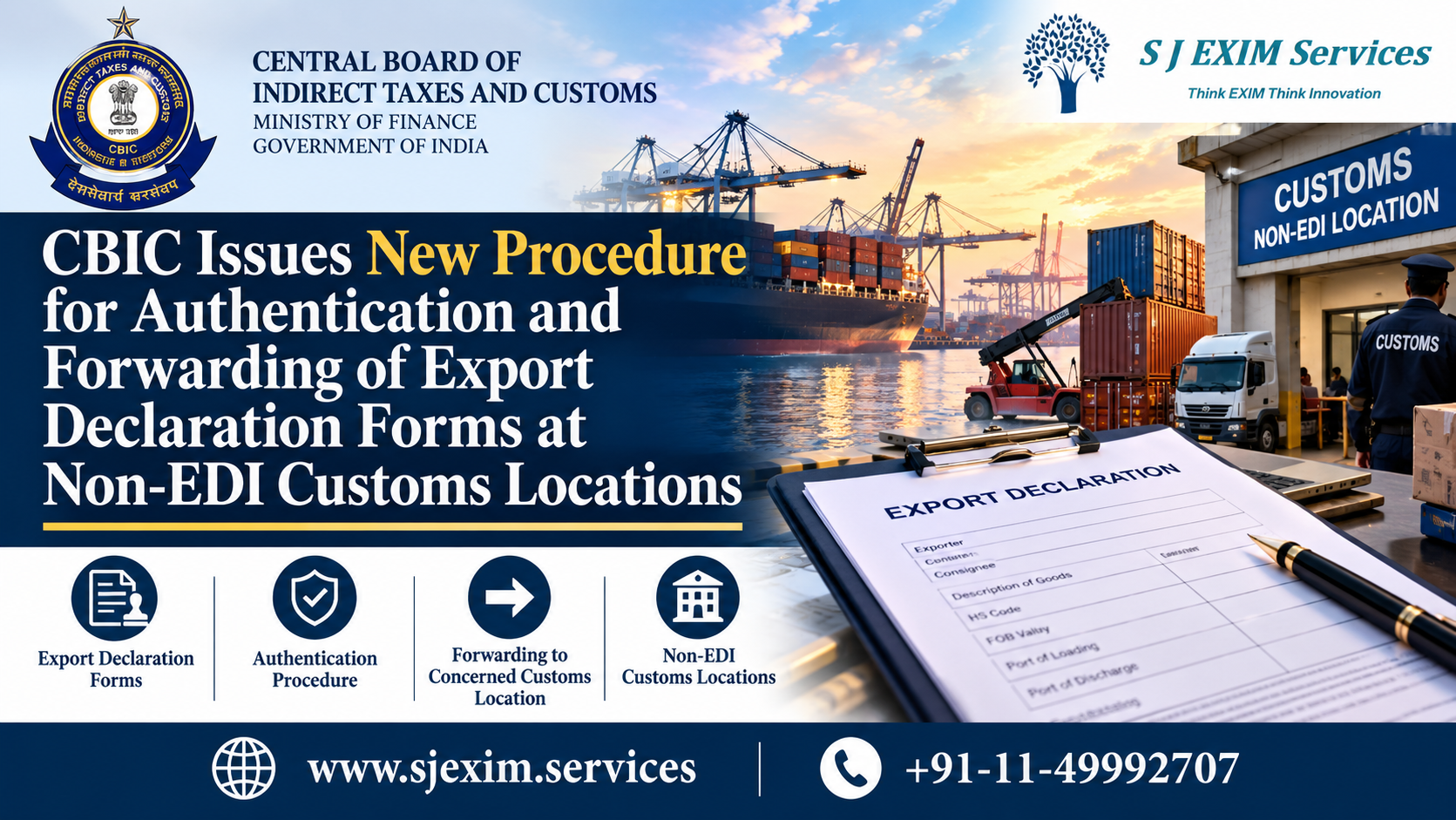
CBIC Issues New Procedure for Authentication and Forwarding of Export Declaration Forms at Non-EDI Customs Locations
The Central Board of Indirect Taxes & Customs (CBIC), Ministry of Finance, has issued Instruction No. 19/2026-Customs dated 5 October 2026, laying down a mechanism for the authentication and forwarding of Export Declaration Forms (EDFs) at Non-EDI Customs locations. The instructions have been issued in the backdrop of the Foreign Exchange Management (Export and Import of Goods and Services) Regulations, 2026, which came into effect from 1 October 2026.
The instruction is particularly relevant for exporters using Non-EDI ports and Customs locations, where the electronic integration ordinarily available through the Shipping Bill mechanism at EDI ports is not available.
Export Declaration Requirement under the New FEMA Regulations
- Under the 2026 Regulations, an exporter is required to furnish an Export Declaration Form (EDF) to the specified authority for authentication. The Commissioner of Customs in the Domestic Tariff Area (DTA) is one of the specified authorities for this purpose.
- CBIC notes that under Regulation 3(1), an exporter of goods must furnish, at the time of export, an EDF declaring the amount representing the full export value of the goods.
- The procedure, however, differs depending upon whether the goods are exported through an EDI or Non-EDI location.
- For goods exported through an Electronic Data Interchange (EDI) port, the EDF is deemed to have been submitted as part of the Shipping Bill. In contrast, where goods are exported through a Non-EDI port, Regulation 3(3) requires the duly authenticated EDF to be forwarded by the specified authority to the concerned Authorised Dealer (AD).
CBIC Prescribes Mechanism for Non-EDI Customs Locations
To operationalise the requirement, CBIC has directed the concerned Commissioners of Customs to ensure transmission of authenticated EDFs to the respective Authorised Dealers.
At Non-EDI Customs locations, the mechanism envisaged by CBIC involves the following:
- Physical EDFs submitted by exporters are to be received and duly authenticated by the specified authority in accordance with the applicable Regulations.
- After authentication, the EDF is to be forwarded to the respective Authorised Dealer mentioned in the EDF.
- As far as practicable, the authenticated EDF should be transmitted electronically from a single official Government email address of the specified authority to the concerned Authorised Dealer.
- Customs formations may establish appropriate internal record-maintenance arrangements for EDFs authenticated and forwarded to Authorised Dealers.
Electronic Transmission Intended to Prevent Forged Documents
- An important compliance safeguard introduced through the instruction is the preference for transmission of authenticated EDFs through an official Government email channel.
- CBIC expressly states that this arrangement is intended to minimise the risk of misuse or submission of forged documents. The mechanism therefore creates a more direct documentary trail between the Customs authority authenticating the EDF and the Authorised Dealer receiving it.
- For exporters and Authorised Dealer banks, this could also help establish a clearer record of authentication and transmission in cases involving subsequent export-realisation or FEMA compliance issues.
Commissioners Must Identify Non-EDI Customs Locations
- CBIC has directed the concerned Commissioners of Customs to identify all Non-EDI Customs locations falling under their respective jurisdictions and ensure that the prescribed mechanism is made operational.
- Significantly, the mechanism is to operate with effect from 1 October 2026, corresponding with the date on which the Foreign Exchange Management (Export and Import of Goods and Services) Regulations, 2026 came into force.
- Accordingly, the instruction dated 5 October 2026 addresses implementation from the effective date of the underlying FEMA Regulations.
RBI to Establish a Single Nodal Point for Authorised Dealers
- The instruction also records an important forthcoming operational development.
- According to CBIC, the Reserve Bank of India (RBI) has informed the Board that it is arranging a single nodal point of Authorised Dealers for receiving authenticated EDFs.
- Once RBI communicates the details of this nodal arrangement, CBIC states that these may be circulated to the concerned Customs formations for necessary action.
- Thus, the 5 October instruction establishes the immediate mechanism, while the nodal arrangement contemplated by RBI is still to be communicated.
What Does This Mean for Exporters?
- For exporters operating through Non-EDI Customs locations, the instruction makes the handling of the EDF an important part of the export documentation and foreign-exchange compliance chain.
- Exporters should ensure that the physical EDF contains accurate particulars, including the full export value, and correctly identifies the relevant Authorised Dealer. They should also maintain documentary records relating to submission and authentication of the EDF, particularly where export proceeds and subsequent FEMA compliance are handled through an AD bank.
- The responsibility for forwarding the authenticated EDF, however, has specifically been placed upon the concerned Customs authority under the mechanism prescribed by CBIC.
EDI vs Non-EDI Export Procedure
| Aspect | EDI Customs Port | Non-EDI Customs Location |
| EDF mechanism | Deemed submitted as part of Shipping Bill | Physical EDF required |
| Authentication | Integrated with electronic export process | Authentication by specified authority |
| Forwarding to AD | Electronic system-based framework | Authenticated EDF to be forwarded to respective AD |
| Preferred transmission | EDI environment | Official Government email, as far as practicable |
| Record keeping | Electronic Customs records | Internal arrangements to maintain authenticated/forwarded EDF records |
| Relevant provision referred by CBIC | Regulation 3 | Regulation 3(3) for forwarding mechanism |
The distinction is expressly recognised in CBIC’s instruction: while an EDF for exports through an EDI port forms part of the Shipping Bill mechanism, Non-EDI exports require a separately authenticated EDF and its onward transmission to the Authorised Dealer.
Compliance Significance
Instruction No. 19/2026-Customs creates an administrative bridge between Customs export documentation and FEMA export-value reporting requirements at locations that are not operating through the EDI framework.
The emphasis on authenticated EDFs, official electronic transmission and maintenance of records is intended to strengthen the integrity and traceability of export declarations while reducing the possibility of forged or improperly transmitted documents. CBIC has directed that these requirements be brought to the notice of officers at all concerned Non-EDI Customs locations for strict compliance, while implementation difficulties may be brought to the Board’s notice.
In case you face any issues related to Indirect Tax-Customs, GST, Foreign Trade Policy (FTP), Arbitration matters and Central Licensing and related advisory matters in India then please feel free to get in touch with SJ EXIM Services.
We offer Legal advice and litigation support in matters related to Indirect Tax-Customs, FTP, other Indirect Tax matters & Arbitration law, all sorts of Central licensing and related matters. Come and explore the new way of doing business with us!
We specialize in paralegal services, litigation support, tax and regulatory matters, delivering reliable, efficient, and result-oriented legal assistance.
Source: CBIC, Ministry of Finance, Govt. of India
Handy Download:
Connect with us for more-
@ Team S J EXIM SERVICES, New Delhi, IN
CP: Ms. Shubhra Jha, Founder
Tel: +91-11-4999 2707 I +91-9999005693
Web: www.sjexim.services
EMAIL: operations@sjexim.services I shubhra@sjexim.services
Facebook: www.facebook.com/sjeximservices
LinkedIn: https://www.linkedin.com/company/90794255/admin/feed/posts/
YouTube: https://www.youtube.com/@aadrikaalawindia
Subscribe our WhatsApp Channel: https://whatsapp.com/channel/0029VaTxDT8JZg4CHEOSoK47
Subscribe our Telegram Channel: https://t.me/sjeximindia






Leave a Reply