

“Indirect Tax I Indirect Tax Litigation I Customs & FTP I Central Licensing I Arbitration I Advisory”
Dated: 29.10.2026
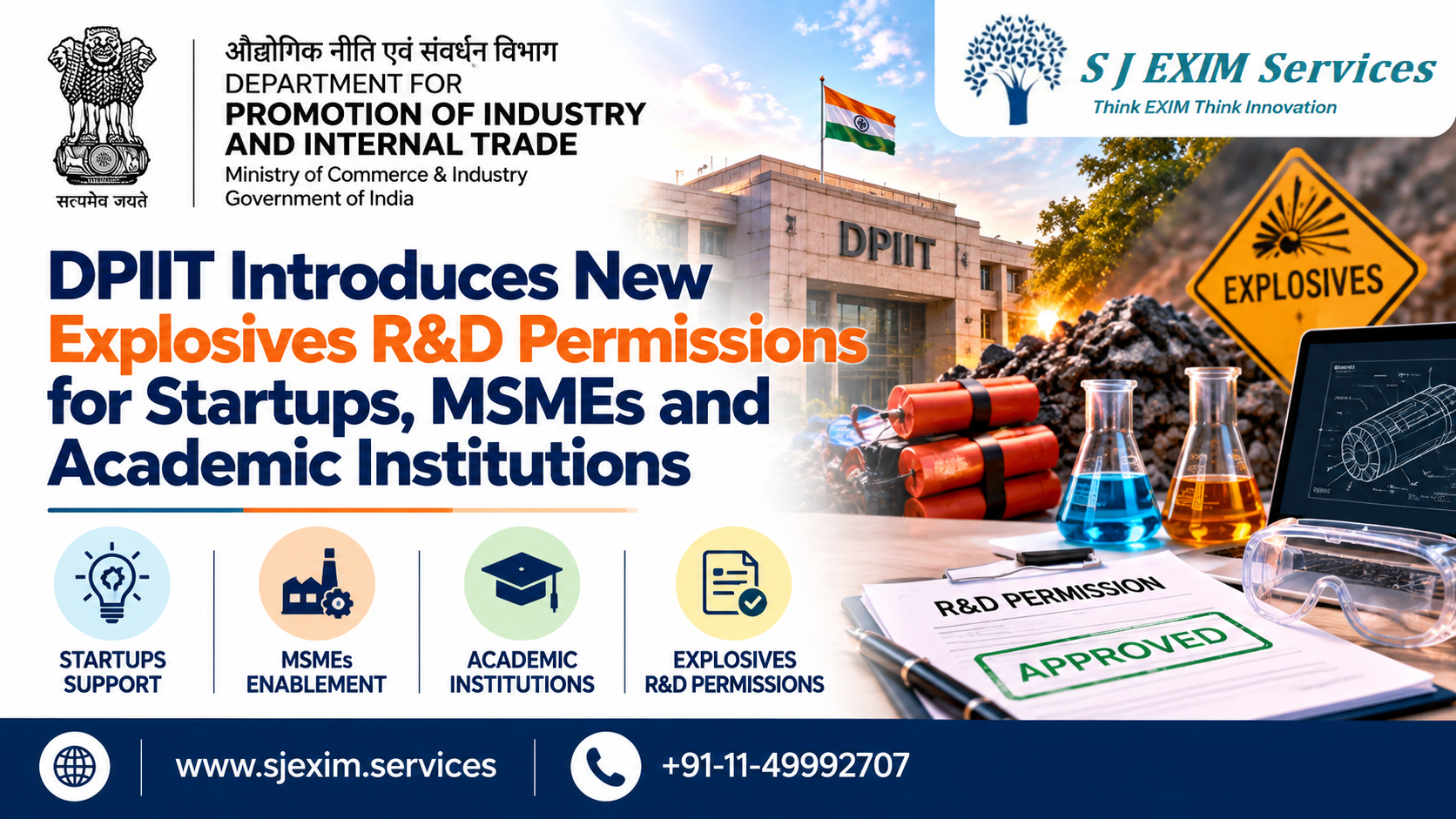
DPIIT Introduces New Explosives R&D Permissions for Startups, MSMEs and Academic Institutions
India’s Explosives (Second Amendment) Rules, 2026 establish a dedicated permission framework for limited-scale explosives research and development while tightening the compliance position of private defence-explosive manufacturers.
Published on 14 October 2026, the amendments update the Explosives Rules, 2008. The changes recognise the growing role of private industry, startups, academic institutions and research laboratories in defence and explosives innovation, while maintaining strict controls over safety, licensing and accountability.
A defined category for defence explosives
The amendment formally defines “defence explosive” as an explosive intended for the defence sector, including explosives manufactured by private manufacturers. This clarification is important because several exemptions available to government defence establishments do not extend to private defence manufacturers.
Private manufacturers of defence explosives remain subject to restrictions and requirements relating to manufacturing controls, construction standards and other applicable obligations. In practical terms, the rules distinguish between government defence entities and private-sector participants, placing clear compliance responsibilities on the latter.
A new route for explosives R&D laboratories
One of the most significant changes is the creation of a formal permission mechanism for research and development laboratories. A laboratory established by a company, firm, partnership, society, startup or academic institution may seek approval to manufacture, store and use small quantities of explosives for genuine R&D work.
The permission is intended for new explosive compositions and related laboratory research, not commercial activity. The total quantity of explosives manufactured, stored, used, supplied as samples, transported, or deployed in tests and trials must not exceed 5 kg at any one time at the laboratory premises.
This permission does not authorise commercial production, sale, third-party sample supply or field trials. Before moving into commercial manufacture, sale or field trials, the permission holder must obtain the required authorisation under the rules.
Permission process: AE-13 application and LE-13 approval
Applicants must apply to the Chief Controller of Explosives using Form AE-13. Permission, where granted, is issued in Form LE-13 and may include conditions imposed by the Chief Controller.
The application framework calls for substantive compliance documentation, including:
- A covering letter and completed Form AE-13
- Passport-size photograph of the applicant or occupier
- Detailed project report and safety-management plan
- Details of laboratory facilities
- Qualifications and experience of technical personnel
- Site, layout and as-built drawings aligned with the relevant STEC Pamphlet
- Registered lease deed or rent agreement in the applicant’s name
- No-objection certificate from the district authority in Form AE-12
- Completion certificate and self-declaration of construction compliance
- Firm registration certificate
The LE-13 permission records the approved purpose, types and quantities of explosives, premises, drawings, laboratory facilities and applicable conditions. It is valid for three years and can be suspended or revoked for breach of the Act, the rules or the permission conditions.
Safety standards for defence explosives
For defence explosives, the applicable safety distances for manufacture, storage and use must follow the Storage and Transport of Explosives Committee (STEC) Pamphlet. These guidelines are issued by the Centre for Fire, Explosive and Environment Safety under the Defence Research and Development Organisation.
Existing licensed premises receive a limited transition period: the new safety-distance requirement does not apply to approved premises already in existence for three years from publication. However, the requirement applies immediately where there is an expansion of licensed capacity, a new process, manufacture of an explosive in a higher Hazard Division, or licence transfer.
Research flexibility with firm operational limits
The amendments create controlled flexibility for laboratories conducting non-commercial R&D. Research laboratories with valid rule 9 permission may undertake limited work on new explosive compositions, within the 5 kg cap. Field trials at Armed Forces, Ministry of Defence, DRDO or Defence Public Sector Undertaking premises may be exempted from certain requirements when the relevant entity provides concurrence and clearance.
The framework therefore supports experimentation and development while retaining approval, site-control, quantity-control and safety-management safeguards.
Expanded recognition of eligible applicants
The rules broaden who may act as an occupier or responsible representative for regulatory purposes. They expressly address academic institutions, foreign companies and partnerships. For example, an academic institution may be represented by its head, Vice-Chancellor, Director, Principal, Dean or a nominated individual. A foreign company must use a director resident in India, while a partnership must use a partner resident in India.
This provides clearer accountability for organisations seeking permissions or licences.
Digital payments and support for smaller enterprises
All fees payable to the Chief Controller, Controller or District Magistrate must now be paid electronically. The amendment also introduces a separate discounted fee schedule for micro enterprises, small enterprises, startups and women-led enterprises.
For this purpose, a woman-led enterprise is one owned and controlled by a woman holding at least 51% financial interest in its capital. The change is designed to lower administrative barriers for smaller and emerging organisations entering regulated R&D activity.
Stronger cancellation and enforcement provisions
The amendments extend cancellation, suspension and revocation provisions to both licences and R&D permissions. A permission or licence may be cancelled if the holder loses lawful possession of the premises, the no-objection certificate is cancelled, or the premises or facilities are leased to another party.
It may also be suspended or cancelled for violations of the Act, rules or permission conditions. Before suspension or cancellation, the holder must be given an opportunity to be heard. Conviction and sentencing for specified criminal offences involving violence or moral turpitude can also affect eligibility.
What the amendment achieves
The 2026 amendment creates a more structured regulatory path for limited explosives R&D while preserving stringent safeguards for a high-risk activity. It gives startups, academic institutions and industry a defined route to conduct controlled research, but it draws a clear line between laboratory innovation and commercial or field deployment.
For private defence-explosive manufacturers, the message is equally clear: participation in the defence supply chain brings direct obligations on manufacturing, construction and safety compliance. The result is a framework that aims to enable innovation without weakening regulatory oversight over explosives.
In case you face any issues related to Indirect Tax-Customs, GST, Foreign Trade Policy (FTP), Arbitration matters and Central Licensing and related advisory matters in India then please feel free to get in touch with SJ EXIM Services.
We offer Legal advice and litigation support in matters related to Indirect Tax-Customs, FTP, other Indirect Tax matters & Arbitration law, all sorts of Central licensing and related matters. Come and explore the new way of doing business with us!
We specialize in paralegal services, litigation support, tax and regulatory matters, delivering reliable, efficient, and result-oriented legal assistance.
Source: DPIIT
Handy Download:
Connect with us for more-
@ Team S J EXIM SERVICES, New Delhi, IN
CP: Ms. Shubhra Jha, Founder
Tel: +91-11-4999 2707 I +91-9999005693
Web: www.sjexim.services
EMAIL: operations@sjexim.services I shubhra@sjexim.services
Facebook: www.facebook.com/sjeximservices
LinkedIn: https://www.linkedin.com/company/90794255/admin/feed/posts/
YouTube: https://www.youtube.com/@aadrikaalawindia
Subscribe our WhatsApp Channel: https://whatsapp.com/channel/0029VaTxDT8JZg4CHEOSoK47
Subscribe our Telegram Channel: https://t.me/sjeximindia





Leave a Reply