

“Indirect Tax I Indirect Tax Litigation I Customs & FTP I Central Licensing I Arbitration I Advisory”
Dated: 09.07.2026
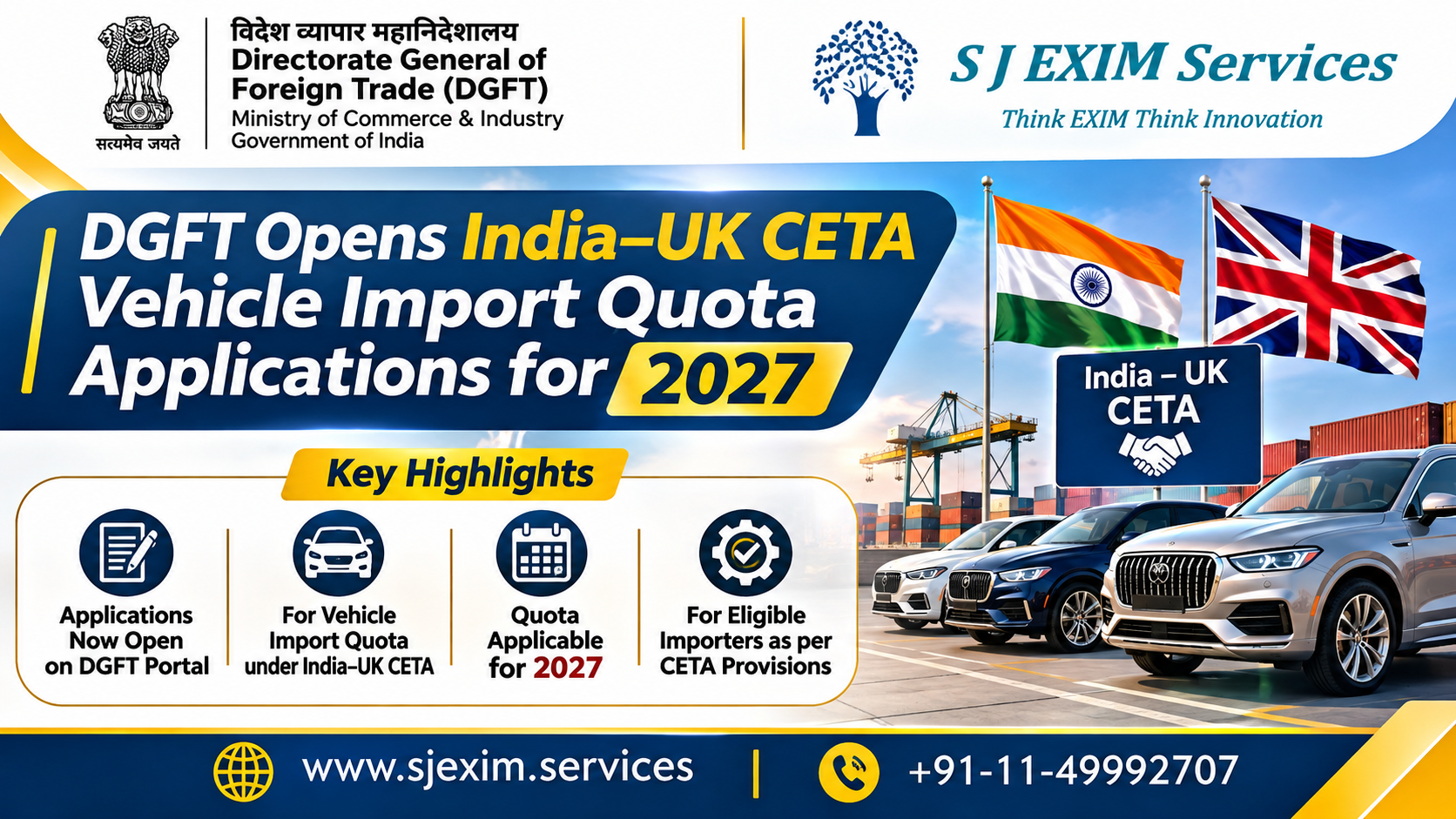
India-UK CETA: New Tariff Rate Quotas for Passenger and Goods Vehicles
The Government of India has introduced significant amendments to its import policy for passenger and goods vehicles under the India-United Kingdom Comprehensive Economic and Trade Agreement (CETA). These changes, notified by the Directorate General of Foreign Trade (DGFT), establish new Tariff Rate Quotas (TRQs) and procedures for importing vehicles from the UK at concessional customs duties. Below is a detailed overview of the new framework and its implications for importers and the automotive industry.
Key Highlights of the TRQ Amendments
1. Annual Import TRQs for Passenger Cars (HS8703)
The amendments introduce annual TRQs for completely built units (CBUs) of passenger cars, categorized by engine capacity:
- More than 3000 cc (petrol) and more than 2500 cc (diesel):
- In-quota tariffs start at 30% (down from a base rate of 110%) and reduce to 10% over 5 years.
- Quota size begins at 10,000 units, increasing to 19,000 by year 5, then gradually reducing to 7,500 units from year 15 onwards.
- 1500 cc (petrol) to 2500 cc (diesel)/3000 cc (petrol):
- In-quota tariffs start at 50% (base rate 66%), reducing to 10% by year 5.
- Quota size starts at 5,000 units, rising to 9,000 by year 5, then tapering to 3,750 units from year 15 onwards.
- Up to 1500 cc:
- Same tariff and quota progression as the previous category.
2. TRQs for Electric, Hybrid, and Hydrogen Passenger Cars
- Below £40,000 CIF: No in-quota tariff, quota size increases from 400 to 2,000 units over the years.
- £40,000 to £80,000 CIF: In-quota tariffs decrease from 50% to 10%, with quota sizes rising from 4,000 to 20,000 units.
- Above £80,000 CIF: In-quota tariffs decrease from 40% to 10%, with quota sizes from 4,400 to 22,000 units.
3. TRQs for Goods Vehicles (HS-8704)
- In-quota duties start at 37% (base rate 44%) and reduce to 8.8% by year 5 and onwards.
- Quota size starts at 2,500 units, increasing to 3,500 units from year 5 onwards.
4. Applicable Tariff Codes
The TRQs apply to a comprehensive list of HS codes covering various types of passenger and goods vehicles, including ICE, electric, hybrid, and hydrogen vehicles.
Application and Allocation Process
- Eligibility: Only Original Equipment Manufacturers (OEMs) and their authorized dealers/channel partners for UK-origin vehicles can apply.
- Pre-purchase Agreement: Applicants must submit a pre-purchase agreement from a UK OEM specifying the quantity to be imported under each TRQ.
- Online Application: All applications must be submitted via the DGFT Import Management System.
- Allocation:
- If total applications are below the quota, all eligible applicants receive their requested quantity.
- If applications exceed the quota, allocation is proportional to each applicant’s request.
- Monitoring and Compliance:
- DGFT monitors cumulative TRQ allocations and issues certificates electronically.
- Importers must present a Certificate of Origin from UK authorities at customs clearance.
- TRQ certificates are valid for up to 12 months or until the end of the calendar year.
- Under-utilization of quota may affect future allocations.
Additional Provisions
- Benefit to Consumers: Importers are expected to pass on the benefit of concessional duties to end buyers.
- Review and Revisions: The TRQ allocation process may be reviewed after two years (from 2028) for effectiveness.
- DGFT Authority: The DGFT reserves the right to modify or add conditions as needed in the public interest.
Implications for the Automotive Sector
These amendments are poised to:
- Enhance market access for UK-manufactured vehicles in India.
- Offer Indian consumers a wider range of vehicles at potentially lower prices due to reduced tariffs.
- Encourage competition and innovation in the Indian automotive market, especially in the electric and hybrid segments.
Conclusion
The new TRQ framework under the India-UK CETA marks a significant step in liberalizing India’s automotive import regime. By providing clear quotas, reduced tariffs, and a transparent allocation process, the policy aims to balance trade facilitation with domestic industry interests.
In case you face any issues related to Indirect Tax-Customs, GST, Foreign Trade Policy (FTP), Arbitration matters and Central Licensing and related advisory matters in India then please feel free to get in touch with SJ EXIM Services.
We offer Legal advice and litigation support in matters related to Indirect Tax-Customs, FTP, other Indirect Tax matters & Arbitration law, all sorts of Central licensing and related matters. Come and explore the new way of doing business with us!
Source: DGFT
Handy Download:
Connect with us for more-
@ Team S J EXIM SERVICES, New Delhi, IN
CP: Ms. Shubhra Jha, Founder
Tel: +91-11-4999 2707 I +91-9999005693
Web: www.sjexim.services
EMAIL: operations@sjexim.services I shubhra@sjexim.services
Facebook: www.facebook.com/sjeximservices
LinkedIn: https://www.linkedin.com/company/90794255/admin/feed/posts/
YouTube: https://www.youtube.com/@sjeximIndia
Subscribe our WhatsApp Channel: https://whatsapp.com/channel/0029VaTxDT8JZg4CHEOSoK47
Subscribe our Telegram Channel: https://t.me/sjeximindia





Leave a Reply