

“Indirect Tax I Indirect Tax Litigation I Customs & FTP I Central Licensing I Arbitration I Advisory”
Dated: 17.08.2026
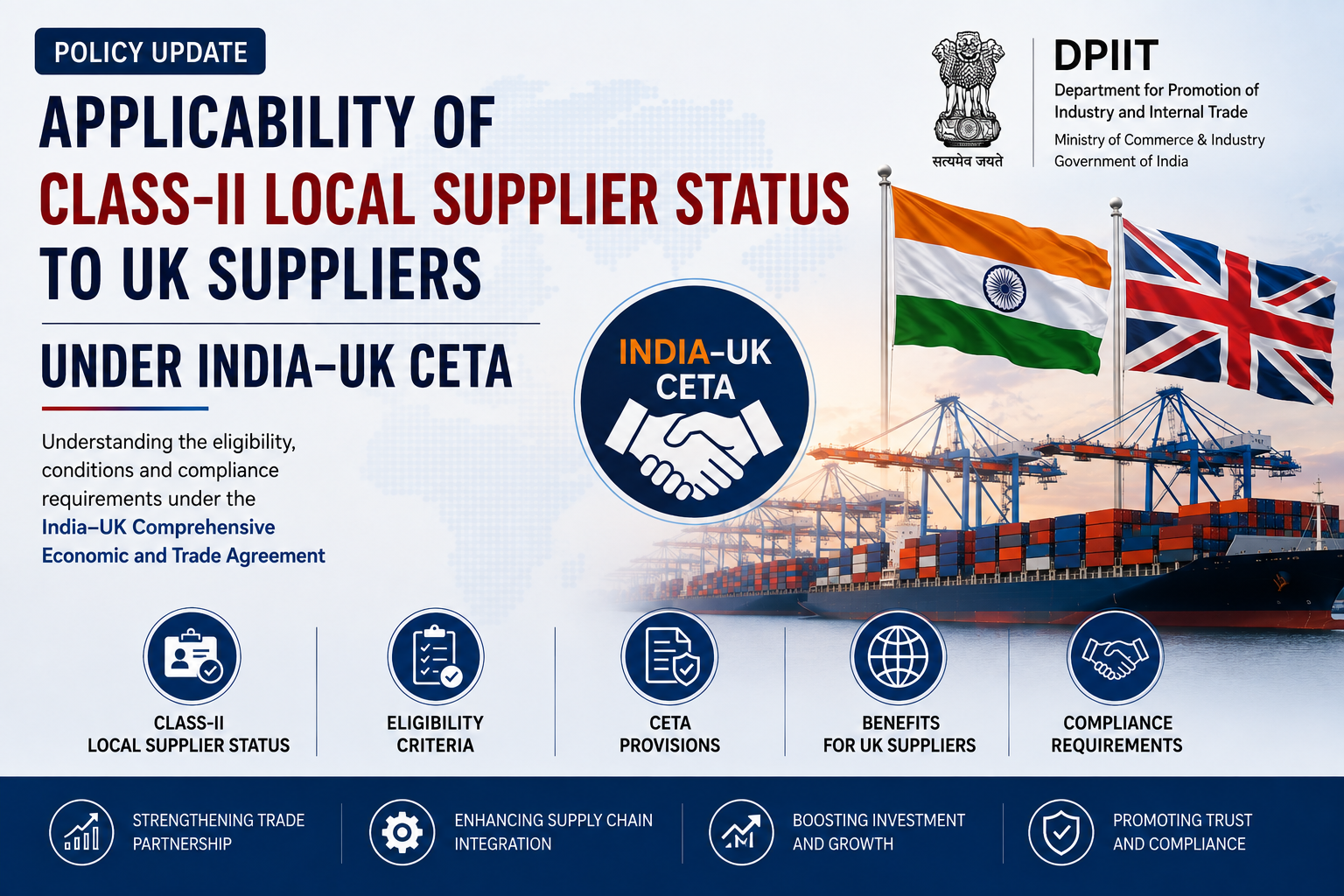
Applicability of Class-II Local Supplier Status to UK Suppliers under India-UK CETA
The Government of India has issued a significant order clarifying the treatment of suppliers from the United Kingdom (UK) under the India-UK Comprehensive Economic and Trade Agreement (CETA) in conjunction with the Public Procurement (Preference to Make in India) Order, 2017 (PPP-MII Order). This article provides a detailed overview of the new provisions, their implications, and actionable guidance for suppliers and procuring entities.
Background and Purpose
The PPP-MII Order, 2017 was established to promote domestic manufacturing and local value addition in India. With the advent of the India-UK CETA, specific provisions now allow UK suppliers to participate in Indian government procurement as “Class-II local suppliers” under certain conditions. This move aims to foster bilateral trade while maintaining the integrity of India’s local content policies.
Key Provisions of the Order
1. Scope and Applicability
- The order applies to all covered procurements by entities listed in Annex 15A (Government Procurement Schedule – Schedule of India) of the India-UK CETA.
- It is subject to procurement thresholds specified in the agreement.
2. Treatment of UK Suppliers
- UK suppliers offering goods, services, or works with the UK as the country of origin are eligible for Class-II local supplier status if they meet the minimum local content requirements.
3. Definition and Calculation of Local Content
- Local content is defined as the value added in the UK, calculated as:
- (Total value of the item procured, excluding net domestic indirect taxes) minus (value of imported content, including all customs duties), divided by the total value, expressed as a percentage.
- Exclusions from local content calculation:
- Imported items sourced locally from UK resellers/distributors.
- License fees, royalties, and technical charges paid outside the UK.
- Repackaged, refurbished, or rebranded imported products.
- For contracts with multiple items, a weighted average is used to determine local content.
4. Minimum Local Content Requirement
- UK suppliers must ensure at least 20% local content (or higher, if prescribed by the relevant Nodal Ministry) to qualify as Class-II local suppliers.
5. Country of Origin Determination
- The country of origin is determined according to the Rules of Origin under the India-UK CETA.
- Bidders must provide a certificate of origin from the designated UK authority.
6. Verification and Certification
- At the time of tender, UK suppliers must self-certify the percentage of local content and provide details of value addition locations.
- For procurements above INR 10 crores, certification from a statutory/cost auditor or practicing accountant is required.
- If the supplier fails to meet the local content requirement post-award, a penalty of up to 10% of the contract value may be imposed, but the contract will not be terminated.
- False declarations can lead to debarment for up to two years and other legal actions.
7. Tender Documentation
- Tender documents must specify the status of UK suppliers as Class-II local suppliers and the applicable minimum local content. This cannot be changed during the procurement process.
8. Other Provisions
- All other aspects, such as preference, eligibility, verification, complaints, and debarment, continue to be governed by the PPP-MII Order, 2017.
- Ministries with their own Cabinet-approved local content policies (post-January 2015) will have those policies prevail over this order.
- The order does not apply to tenders issued before its effective date (07 July 2026).
Practical Steps for UK Suppliers and Procuring Entities
- UK Suppliers:
- Ensure your goods/services meet the minimum 20% local content requirement in the UK.
- Prepare accurate self-certification and, for large contracts, obtain auditor certification.
- Maintain detailed documentation of value addition and country of origin.
- Procuring Entities:
- Clearly specify the status and requirements for UK suppliers in all tender documents.
- Verify certifications and conduct random or complaint-based audits as needed.
- Impose penalties and update debarment lists in case of violations.
Conclusion
This order streamlines the participation of UK suppliers in Indian government procurement, balancing international trade commitments with the goal of promoting local value addition. Both suppliers and procuring entities must adhere strictly to the outlined procedures to ensure compliance and maximize the benefits of the India-UK CETA.
Related Articles
In case you face any issues related to Indirect Tax-Customs, GST, Foreign Trade Policy (FTP), Arbitration matters and Central Licensing and related advisory matters in India then please feel free to get in touch with SJ EXIM Services.
We offer Legal advice and litigation support in matters related to Indirect Tax-Customs, FTP, other Indirect Tax matters & Arbitration law, all sorts of Central licensing and related matters. Come and explore the new way of doing business with us!
We specialize in paralegal services, litigation support, tax and regulatory matters, delivering reliable, efficient, and result-oriented legal assistance.
Source: DPIIT
Handy Download:
Connect with us for more-
@ Team S J EXIM SERVICES, New Delhi, IN
CP: Ms. Shubhra Jha, Founder
Tel: +91-11-4999 2707 I +91-9999005693
Web: www.sjexim.services
EMAIL: operations@sjexim.services I shubhra@sjexim.services
Facebook: www.facebook.com/sjeximservices
LinkedIn: https://www.linkedin.com/company/90794255/admin/feed/posts/
YouTube: https://www.youtube.com/@aadrikaalawindia
Subscribe our WhatsApp Channel: https://whatsapp.com/channel/0029VaTxDT8JZg4CHEOSoK47
Subscribe our Telegram Channel: https://t.me/sjeximindia




Leave a Reply