

“Indirect Tax I Indirect Tax Litigation I Customs & FTP I Central Licensing I Arbitration I Advisory”
Dated: 28.09.2026
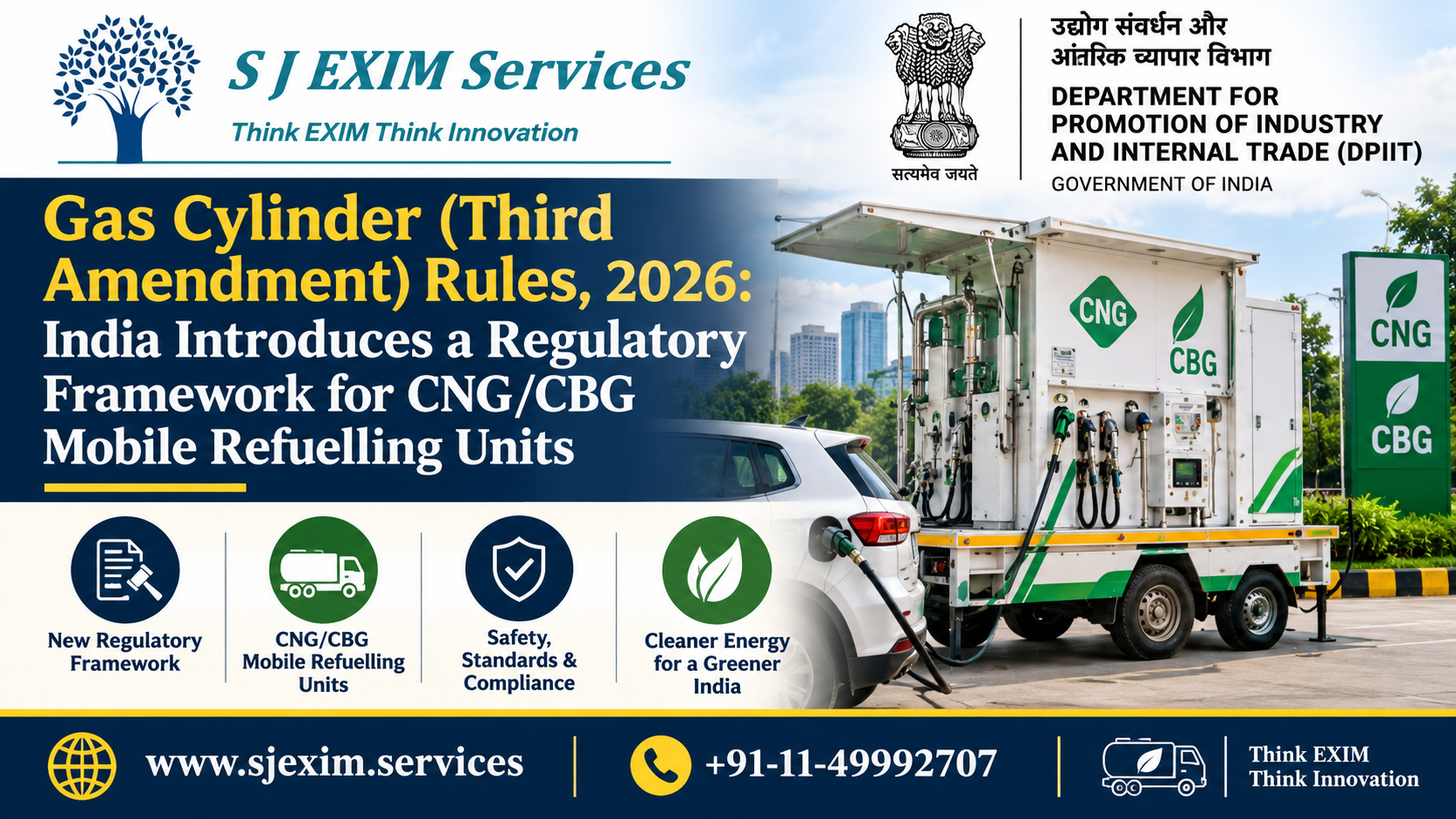
Gas Cylinder (Third Amendment) Rules, 2026: India Introduces a Regulatory Framework for CNG/CBG Mobile Refuelling Units
India has introduced a detailed statutory framework governing CNG/CBG Mobile Refuelling Units (MRUs) through the Gas Cylinder (Third Amendment) Rules, 2026. The amendment is particularly significant for industries where vehicles, locomotives, vessels, heavy machinery or equipment cannot conveniently be brought to conventional fuel-dispensing stations.
The Central Government notified G.S.R. 831(E) dated 21 September 2026, exercising powers under Sections 5 and 7 of the Explosives Act, 1884, to further amend the Gas Cylinders Rules, 2016. The amendment follows the publication of draft rules under G.S.R. 461(E) dated 10 June 2026 and consideration of objections and suggestions received from stakeholders. 276432
The amendment creates a regulated mechanism for mobile CNG and CBG refuelling while imposing substantial licensing, safety, operational, technical, record-keeping and emergency-response obligations.
1. What Has Changed?
- The amendment makes two principal changes to the Gas Cylinders Rules, 2016.
- First, a proviso has been inserted into Rule 6(4) permitting CNG/CBG to be dispensed into motor vehicles or specified equipment in accordance with the newly inserted Condition 22 of Form G.
- Second, and more substantially, Condition 22 – “Additional conditions for CNG/CBG Mobile Refueling Units (MRUs)” has been inserted into Form G.
- This new Condition 22 establishes a comprehensive regulatory architecture for the ownership, approval, filling, movement and operation of CNG/CBG MRUs.
2. What Is a CNG/CBG Mobile Refuelling Unit?
The Rules define a CNG/CBG Mobile Refuelling Unit or MRU as a mobile assembly comprising:
- CNG/CBG storage cascade;
- dispensing unit;
- piping;
- hoses;
- couplings;
- valves;
- pressure-regulating devices;
- safety fittings;
- emergency shut-down system; and
- other associated equipment.
The assembly may be mounted on a vehicle, trailer, skid or other mobile platform and is intended to dispense CNG/CBG into approved onboard fuel cylinders or fuel systems at a site specifically approved for that purpose.
The significance of the amendment therefore goes beyond merely permitting a “mobile fuel station.” It establishes a controlled system for taking gaseous fuel to specified categories of equipment and vehicles subject to statutory approvals and safety conditions.
3. Ownership and Approval Requirements
- The amendment differentiates between CNG and CBG MRUs.
- A CNG MRU must be owned by a City Gas Distribution (CGD) company authorised for the concerned geographical area.
- A CBG MRU, on the other hand, must be owned by a licensee under Forms E & F.
- In both cases, the assembly must be approved by the Chief Controller and the approval extends to critical components and operational arrangements including the storage cascade, dispensing system, piping, hoses, pressure-regulating devices, safety fittings, ESD system, layout, operating procedures and emergency-response arrangements.
- This makes prior regulatory approval an integral part of the MRU framework rather than treating mobile dispensing merely as an extension of an existing fuel-distribution activity.
4. Where Can Mobile Refuelling Be Used?
One of the most important aspects of the amendment is the identification of situations in which mobile CNG/CBG refuelling may be undertaken.
CNG/CBG may be dispensed into onboard cylinders fitted as fuel tanks in specified categories, including:
Mines and Ports
- Non-transport vehicles operating within areas covered by the Mines Act, 1952, or within ports notified by the Ministry of Ports, Shipping and Waterways, may fall within the permitted framework.
Indian Railways
- The amendment expressly covers locomotives of the Indian Railways.
Ships and Boats
- It also extends to ships or boats operating on inland or seaborne waterways, subject to approval from the competent maritime/inland waterways authority, including the Maritime Board, Inland Waterways Authority of India or concerned port authority.
Heavy Equipment and Machinery
- A particularly important provision addresses heavy equipment, machinery and other heavy vehicles that cannot be brought to conventional fuel-dispensing stations.
- In exceptional circumstances, the Chief Controller may permit their refuelling, with reasons recorded in writing and subject to additional safeguards, site inspection, risk assessment and other conditions considered necessary.
- This provision may have considerable practical relevance for mining, infrastructure, construction, industrial, port and similar operations involving large or relatively immobile equipment.
5. MRUs Cannot Be Filled Anywhere
The mobility of an MRU does not mean that the unit itself may be charged from any location.
The Rules require the CNG/CBG MRU to be filled or charged only in:
a designated area of a CNG mother station, or
CNG/CBG filling premises licensed under Forms E & F.
- The MRU must also be reflected in the approved layout and attached to the relevant mother station or licensed premises. Necessary amendments to the licence of the premises to which the MRU is attached must also be obtained.
- This creates an important distinction between the charging point of the MRU and the approved location where mobile dispensing subsequently takes place.
6. Dispensing Sites Also Require Regulatory Control
- The amendment does not authorise unrestricted mobile dispensing.
- The MRU may dispense CNG/CBG into qualifying onboard cylinders only at premises licensed in Form G, subject to the exceptions specified in the amendment.
- Accordingly, businesses considering mobile CNG/CBG solutions should not assume that ownership or approval of an MRU by itself permits refuelling at any industrial or commercial location.
- The approvals relating to the MRU, source premises, dispensing premises and receiving vehicle/equipment must be examined together.
7. Mandatory Safety Distances
During dispensing operations, prescribed safety distances around the MRU must be maintained.
| Total Water Capacity of Gas Storage Cascade | Minimum Distance from Buildings/Boundaries |
| Up to 4,500 litres | 4 metres |
| More than 4,500 litres | 5 metres |
The Chief Controller may require greater distances from public roads, ignition sources, overhead electrical lines, drains, basements, hazardous storage areas and other vulnerable locations.
Further, an MRU having a total water capacity exceeding 10,000 litres cannot be used unless specifically permitted by the Chief Controller with additional safeguards.
8. Emergency Shut-Down System Becomes a Core Safety Requirement
- Every CNG/CBG MRU must have a fail-safe, manually operable Emergency Shut Down (ESD) system.
- The system must be operable from at least two accessible locations and capable of isolating the storage cascade and dispensing lines, shutting off the CNG/CBG supply and immediately terminating dispensing operations.
- Periodic testing must also be conducted in accordance with the manufacturer’s prescribed procedure.
- This requirement places both equipment design and continuing maintenance within the compliance framework.
9. Technical Standards for Cylinders
The storage cascade cylinders used in an MRU must conform to:
- IS 7285, ISO 9809, ISO 11119, or another code acceptable to the Chief Controller.
- Their maximum allowable working pressure ordinarily cannot exceed 250 bar gauge, unless another pressure is specifically approved by the Chief Controller.
- Periodic testing, inspection and certification are mandatory, while valves, pressure-relief devices and fittings must be of approved types.
10. Hose and Coupling Requirements
The amendment also goes into considerable technical detail concerning the equipment used to transfer CNG/CBG.
Hoses and couplings must:
- be suitable for CNG/CBG service;
- maintain mechanical and electrical continuity;
- have minimum burst pressure of at least four times the maximum operating pressure;
- undergo periodic pressure/leak testing;
- incorporate breakaway coupling;
- have excess-flow or quick shut-off arrangements; and
- have appropriate bonding/earthing arrangements.
These provisions make equipment specifications and maintenance records important elements of regulatory compliance.
11. Approved List of Vehicles and Equipment
Mobile refuelling is not intended to operate as an unrestricted facility for any vehicle arriving at an approved site.
The proposed list of vehicles to be refuelled must be vetted by the relevant competent authority, which may include the:
- Directorate General of Mines Safety;
- Conservator of Ports;
- concerned Railway Administration;
- Inland Waterways Authority of India; or
- another competent jurisdictional authority.
The approved list must be maintained at the site and updated before any new vehicle or equipment is refuelled.
This creates an important compliance checkpoint for operators.
12. Trained Personnel and Direct Supervision
- Refuelling operations must take place under the presence and direct supervision of at least one authorised and trained responsible person of the CGD entity or relevant licensee.
- Training records must be maintained and produced when demanded. The responsible person must be familiar with CNG/CBG hazards, relevant provisions of the Gas Cylinders Rules and Form G licence conditions.
- Likewise, filling of the MRU itself must be undertaken under the direct supervision of appropriately trained responsible personnel.
- Businesses therefore need not only compliant equipment but also a demonstrable personnel competency and training system.
13. Site-Specific Emergency Plan Is Mandatory
Each site must have its own site-specific emergency plan.
A copy is required to be submitted, as specified, to the:
- District Magistrate;
- local fire service;
- police authority; and
- jurisdictional Controller/Chief Controller.
The emergency plan must also be displayed at the site, communicated to operators and tested periodically through mock drills.
This is a significant compliance requirement because emergency preparedness is transformed from an internal operating practice into a documented regulatory obligation involving local authorities.
14. No General Public Retail Dispensing
A critical limitation should be noted.
The MRU cannot be used for public retail dispensing on:
- public roads;
- residential areas;
- commercial parking areas;
- basements;
- enclosed premises; or
- any place not specifically approved.
Accordingly, the amendment should not be interpreted as permitting unrestricted “doorstep CNG delivery” to the general public.
The regulatory model is substantially more controlled and is tied to approved locations, equipment, operators and specified operational circumstances.
15. Detailed Records Must Be Maintained
The CGD entity or relevant Form E & F licensee must maintain records covering:
MRU filling → dispensing → pressure readings → vehicle/equipment particulars → operator details → leak checks → ESD checks → hose testing → maintenance → defects → repairs → incidents.
- These records must be produced before the inspecting authority on demand.
- For businesses, this means that compliance cannot end with obtaining a licence or approval. Continuous documentary compliance and audit readiness will be equally important.
16. What Does the Amendment Mean for Industry?
- The amendment is especially relevant to businesses operating in sectors where fixed-site refuelling creates operational difficulties.
- Potentially affected sectors include mining, ports, railways, inland waterways, shipping, heavy engineering and infrastructure operations, subject in every case to the categories, approvals and conditions prescribed under the Rules.
- The amendment provides a statutory pathway for mobile CNG/CBG refuelling, but it deliberately couples that flexibility with stringent safety and licensing controls.
For industry, therefore, the commercial question should not merely be:
“Can an MRU technically reach our machinery?”
The regulatory questions are equally important: Who owns the MRU? Where is it charged? Is the assembly approved? Is the destination premises appropriately licensed? Is the receiving equipment eligible? Has the competent authority vetted the vehicle/equipment? Are the safety distances available? Is the emergency plan in place? Are trained personnel and compliance records available?
17. Practical Compliance Checklist
Before commencing an MRU operation, businesses should examine at least the following:
- Ownership eligibility of the CNG/CBG MRU;
- Chief Controller approval of the complete MRU assembly;
- Appropriate Form E & F / Form G licensing, as applicable;
- Amendment of the relevant premises licence to incorporate MRU particulars;
- Valid filling permissions and other statutory approvals;
- Eligibility and approval of the receiving vehicle/equipment;
- Vetting of the proposed vehicle/equipment list by the competent authority;
- Compliance with minimum safety distances and capacity restrictions;
- Conformity of cylinders with prescribed IS/ISO standards;
- ESD, hoses, couplings, PRDs, earthing and associated safety systems;
- Training and authorisation of responsible personnel;
- Site-specific risk assessment and emergency-response planning;
- Leak-testing, inspection and preventive maintenance systems;
- Mandatory operational and maintenance records; and
- Compliance with applicable requirements governing movement/transport of the MRU.
Conclusion
The Gas Cylinder (Third Amendment) Rules, 2026 represent an important regulatory development in India’s transition toward alternative gaseous fuels.
Rather than simply liberalising mobile CNG/CBG dispensing, the amendment creates a permission-based and safety-intensive framework under which mobile refuelling can be deployed for specified vehicles, equipment and industrial applications.
For mining operations, ports, railways, maritime and inland-waterway operators, and certain heavy-equipment users, the framework may address a genuine operational difficulty: bringing large or location-bound equipment to conventional refuelling stations.
At the same time, businesses seeking to use the framework will need to carefully map the PESO/Chief Controller approvals, licensing architecture, site conditions, equipment standards, competent-authority permissions, safety systems, training requirements and record-keeping obligations before commencing operations.
The Rules came into force upon their final publication in the Official Gazette. The notification itself records that the principal Gas Cylinders Rules were originally notified on 22 November 2016 and lists the subsequent amendments through June 2026.
In case you face any issues related to Indirect Tax-Customs, GST, Foreign Trade Policy (FTP), Arbitration matters and Central Licensing and related advisory matters in India then please feel free to get in touch with SJ EXIM Services.
We offer Legal advice and litigation support in matters related to Indirect Tax-Customs, FTP, other Indirect Tax matters & Arbitration law, all sorts of Central licensing and related matters. Come and explore the new way of doing business with us!
We specialize in paralegal services, litigation support, tax and regulatory matters, delivering reliable, efficient, and result-oriented legal assistance.
Source: DPIIT
Handy Download:
Connect with us for more-
@ Team S J EXIM SERVICES, New Delhi, IN
CP: Ms. Shubhra Jha, Founder
Tel: +91-11-4999 2707 I +91-9999005693
Web: www.sjexim.services
EMAIL: operations@sjexim.services I shubhra@sjexim.services
Facebook: www.facebook.com/sjeximservices
LinkedIn: https://www.linkedin.com/company/90794255/admin/feed/posts/
YouTube: https://www.youtube.com/@aadrikaalawindia
Subscribe our WhatsApp Channel: https://whatsapp.com/channel/0029VaTxDT8JZg4CHEOSoK47
Subscribe our Telegram Channel: https://t.me/sjeximindia






Leave a Reply