

“Indirect Tax I Indirect Tax Litigation I Customs & FTP I Central Licensing I Arbitration I Advisory”
Dated: 30.09.2026
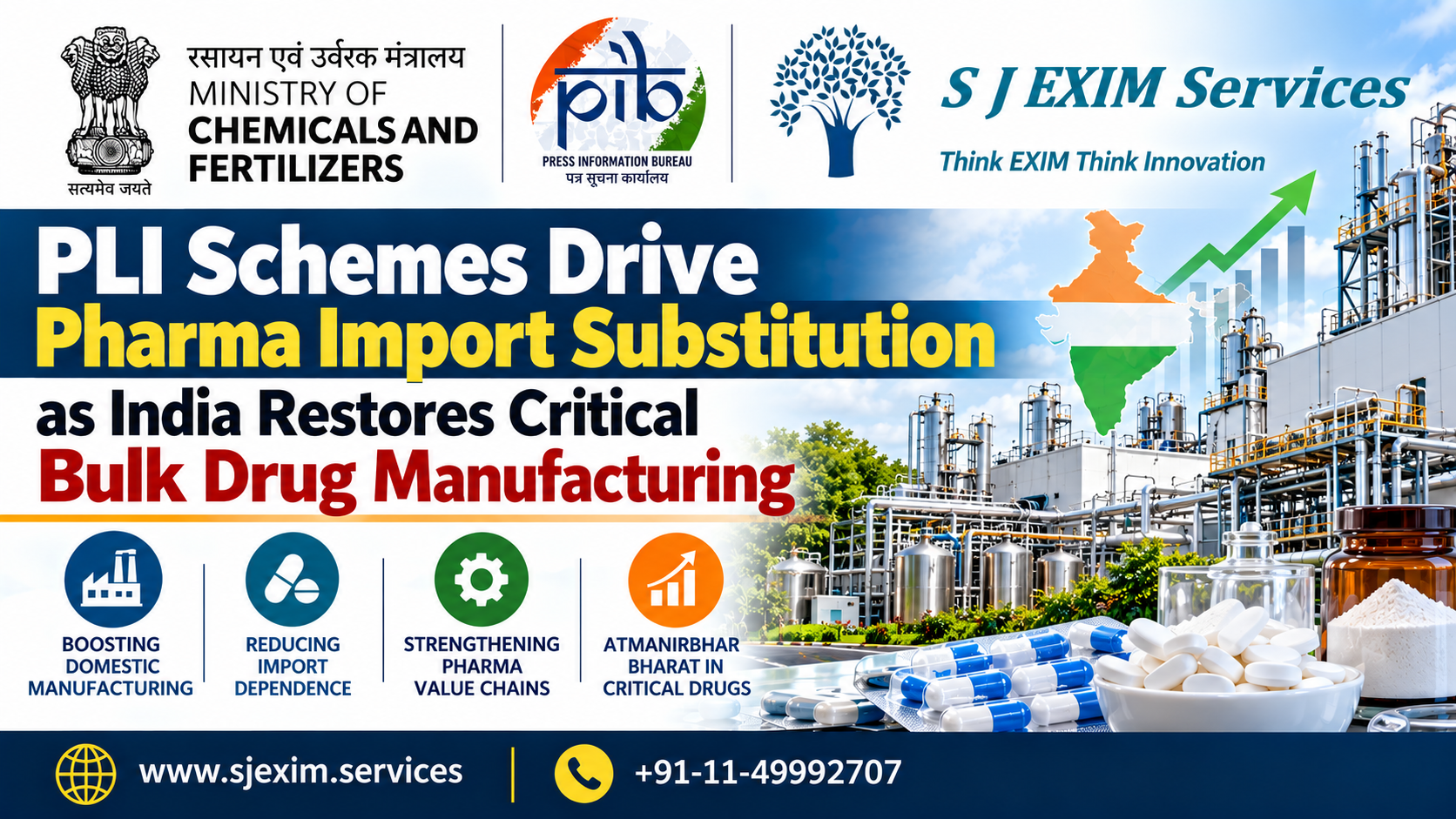
PLI Schemes Drive Pharma Import Substitution as India Restores Critical Bulk Drug Manufacturing
The Government of India has highlighted the growing impact of its Production Linked Incentive (PLI) Schemes for pharmaceuticals, bulk drugs and medical devices, with substantial investments translating into new domestic manufacturing capacity, reduced dependence on imported critical pharmaceutical inputs and expansion of India’s medical-device manufacturing ecosystem.
According to releases issued by the Department of Pharmaceuticals, Ministry of Chemicals and Fertilizers, the Government’s strategy is focused particularly on strengthening domestic production of Key Starting Materials (KSMs), Drug Intermediates (DIs), Active Pharmaceutical Ingredients (APIs), high-value pharmaceuticals and advanced medical devices.
A separate government release on the PLI Scheme for Bulk Drugs also highlights five greenfield projects that have commenced manufacturing critical ingredients used in antibiotics, cardiovascular medicines and Paracetamol.
Three Major PLI Schemes Driving Pharma and MedTech Manufacturing
The Government’s pharmaceutical manufacturing strategy is being implemented principally through three PLI schemes:
- PLI Scheme for Bulk Drugs – KSMs, DIs and APIs
- PLI Scheme for Pharmaceuticals
- PLI Scheme for Promoting Domestic Manufacturing of Medical Devices
According to the Government, these schemes are collectively supporting expansion of manufacturing capacity across critical pharmaceutical ingredients, high-value medicines and advanced medical devices.
The broader policy objective is significant: India is seeking not merely to expand pharmaceutical output, but to strengthen the entire domestic manufacturing and supply-chain ecosystem, particularly for products and inputs where dependence on overseas sources has historically created vulnerabilities.
PLI Scheme for Bulk Drugs: Reducing Import Dependence
- The PLI Scheme for Bulk Drugs was approved in 2020 with a total financial outlay of ₹6,940 crore.
- The scheme was designed to strengthen domestic manufacturing of 41 identified critical bulk drugs, particularly KSMs, DIs and APIs for which India had significant import dependence.
- As of June 2026, the Government reported that 38 projects had been approved, with approximately ₹4,763.27 crore of investment made—exceeding the committed investment of ₹4,070 crore. Twenty-seven projects covering 36 KSMs/DIs/APIs had been commissioned.
- The scheme has also enabled domestic production of critical fermentation-based products such as Penicillin-G, Clavulanic Acid and Rifampicin, which had earlier been largely dependent on imports.
Penicillin G Manufacturing Returns to India After Nearly Three Decades
- One of the most notable projects highlighted by the Government is the Penicillin G manufacturing facility established by Lyfius Pharma Pvt. Ltd., a subsidiary of Aurobindo Pharma Limited, at Kakinada SEZ in Andhra Pradesh.
- The project involved an investment of approximately ₹2,270.05 crore and has an installed capacity of 15,000 MT per annum. It has generated 2,353 direct jobs and recorded cumulative production of approximately ₹1,191 crore.
- Penicillin G is a critical fermentation-based KSM used for producing intermediates such as 6-APA, which are subsequently used in widely prescribed antibiotics including amoxicillin and ampicillin.
- Significantly, the Government states that the project achieved more than 90% domestic value addition and restored domestic manufacturing of Penicillin G after a gap of about three decades.
- This is particularly important from the perspective of pharmaceutical supply-chain security because it addresses a strategically concentrated vulnerability in India’s antibiotic manufacturing ecosystem.
India’s First Fermentation-Based Potassium Clavulanate Facility
- The Government also highlighted the project of Kinvan Private Limited, a DPB Group company, which has established a 400 MT per annum fermentation-based manufacturing facility for Clavulanic Acid (Potassium Clavulanate) at Nalagarh, Himachal Pradesh.
- According to the release, the project involved an investment of ₹504.68 crore, generated 465 direct jobs, and recorded cumulative production of ₹413 crore.
- The Government describes this as India’s first fermentation-based manufacturing facility for Potassium Clavulanate.
- Clavulanic Acid is a β-lactamase inhibitor commonly combined with penicillin-group antibiotics such as amoxicillin to improve their effectiveness against resistant bacteria.
- The project therefore represents both import substitution and an expansion of India’s indigenous fermentation-based pharmaceutical manufacturing capability.
Domestic Production of Sulfadiazine, Telmisartan and Olmesartan
Andhra Organics Limited (AOL), a wholly owned subsidiary of Virchow Laboratories Limited, has commissioned manufacturing facilities for:
Sulfadiazine, Telmisartan and Olmesartan
- at Pydibhimavaram in Srikakulam district of Andhra Pradesh.
- The projects involved a combined investment of ₹151.47 crore and generated 221 direct employment opportunities. The company developed the manufacturing technology in-house and established greenfield production facilities.
- The Government further reports that domestic production of Sulfadiazine has contributed to a substantial reduction in India’s import dependence, with imports declining by approximately 73% compared with the FY 2019-20 baseline.
Para Amino Phenol: Strengthening the Paracetamol Supply Chain
- Another strategically important project is the manufacturing facility established by Meghmani LLP for Para Amino Phenol (PAP) at Dahej, Gujarat.
- The facility has a manufacturing capacity of 13,500 MT per annum and involved an investment of ₹60.46 crore.
- PAP is a critical starting material used in the manufacture of Paracetamol, one of the country’s most widely consumed medicines for fever and pain relief.
- The Government notes that PAP was previously largely imported. The PLI-supported facility has created large-scale domestic manufacturing capacity and recorded cumulative production of approximately ₹687 crore.
- The project therefore contributes directly to backward integration in India’s Paracetamol manufacturing chain.
Atorvastatin API Manufacturing Gets Domestic Boost
- Centrient Pharmaceuticals India Private Limited has established a greenfield Atorvastatin API manufacturing facility at Nawanshahr, Punjab, with an installed capacity of 206 MT per annum.
- The project involved an investment of approximately ₹161.13 crore and recorded cumulative production of ₹432 crore.
- Atorvastatin is widely prescribed for lowering cholesterol and reducing cardiovascular risk.
- According to the Government, the project has developed a supply chain with more than 80% domestic value addition, reducing dependence on imported KSMs and supporting pharmaceutical supply security.
PLI Scheme for Pharmaceuticals
- The broader PLI Scheme for Pharmaceuticals was approved in 2021 with a total financial outlay of ₹15,000 crore.
Unlike the bulk-drug scheme, which concentrates heavily on critical starting materials and APIs, this scheme supports manufacturing across a wider range of pharmaceutical products, including:
- biopharmaceuticals;
- complex generic drugs;
- patented and orphan drugs;
- autoimmune medicines;
- anti-cancer medicines; and
- other high-value pharmaceutical products.
As of June 2026, the Government reported 55 selected applicants, including 20 MSMEs. The scheme had attracted approximately ₹19,300 crore of actual investment, substantially exceeding the targeted investment of ₹17,275 crore.
The Government also reported approximately ₹2,08,673 crore in sales, including exports worth around ₹1,30,681 crore, up to June 2026.
The release identifies companies including Sun Pharmaceutical Industries Limited, Aurobindo Pharma Limited, Dr. Reddy’s Laboratories Limited, Cipla Limited, Biocon Limited and Torrent Pharmaceuticals Limited among companies that have expanded manufacturing capacity for complex generics, biosimilars, autoimmune medicines and other high-value pharmaceuticals.
PLI Scheme for Medical Devices
- The Government is simultaneously seeking to strengthen India’s medical-device manufacturing capabilities.
- The PLI Scheme for Promoting Domestic Manufacturing of Medical Devices was approved in 2020 with a total financial outlay of ₹3,420 crore.
- The scheme provides a 5% incentive on incremental sales of eligible medical devices manufactured in India for a period of five years.
It covers four broad segments:
- Cancer care/radiotherapy devices; radiology and imaging devices; anaesthetics and cardio-respiratory devices; and implants, including implantable electronic devices.
- As of June 2026, production of 38 unique medical devices had commenced under the scheme, including CT machines, MRI scanners, Cath Labs, Linear Accelerators, C-Arms, mammography machines, ultrasound systems, anaesthesia machines and heart valves.
- This is significant because several of these categories have historically involved substantial dependence on imported equipment and technology.
PLI Strategy: From Import Dependence to Domestic Supply-Chain Resilience
- Taken together, the three schemes indicate a policy strategy extending beyond simple production incentives.
The Government is attempting to develop domestic capacity at several levels of the pharmaceutical value chain:
KSM → Drug Intermediate → API → Finished Pharmaceutical → Advanced Medical Device
- The bulk-drug PLI is strengthening upstream pharmaceutical raw-material capacity; the pharmaceutical PLI is supporting higher-value formulations and advanced medicines; and the medical-device PLI is targeting sophisticated equipment and devices.
- The five greenfield bulk-drug projects highlighted by the Government are particularly illustrative because they cover both fermentation-based pharmaceutical inputs and chemically synthesised pharmaceutical inputs, including Penicillin G, Potassium Clavulanate, Sulfadiazine, Telmisartan, Olmesartan, Para Amino Phenol and Atorvastatin API.
Trade and Import-Substitution Significance
- From an international-trade and regulatory perspective, the PLI programme has an important import-substitution dimension.
- The Government’s data indicates that investments are being directed toward products where India previously faced material import dependence, particularly critical KSMs, APIs and high-end medical devices.
- The reported 73% reduction in imports of Sulfadiazine compared with the FY 2019-20 baseline, restoration of domestic Penicillin G manufacturing after nearly three decades, creation of domestic PAP capacity and development of an Atorvastatin supply chain with more than 80% domestic value addition illustrate this policy direction.
- The impact is therefore not limited to manufacturing incentives. It extends to supply-chain resilience, backward integration, domestic value addition, import substitution, employment generation and pharmaceutical security.
Key Takeaway
India’s PLI framework for the pharmaceutical and medical-device sectors is increasingly translating from approved incentives into operational manufacturing capacity.
The Government’s September 2026 assessment highlights the restoration or expansion of domestic manufacturing for strategically important products including Penicillin G, Potassium Clavulanate, Sulfadiazine, Para Amino Phenol and Atorvastatin API, alongside broader investments in complex pharmaceuticals and advanced medical devices.
For the pharmaceutical industry, the larger significance lies in the gradual development of an integrated domestic ecosystem—from critical starting materials and APIs to finished medicines and advanced medical devices—while reducing exposure to concentrated international supply chains.
In case you face any issues related to Indirect Tax-Customs, GST, Foreign Trade Policy (FTP), Arbitration matters and Central Licensing and related advisory matters in India then please feel free to get in touch with SJ EXIM Services.
We offer Legal advice and litigation support in matters related to Indirect Tax-Customs, FTP, other Indirect Tax matters & Arbitration law, all sorts of Central licensing and related matters. Come and explore the new way of doing business with us!
We specialize in paralegal services, litigation support, tax and regulatory matters, delivering reliable, efficient, and result-oriented legal assistance.
Source: Ministry of Chemicals & Fertllizers
Handy Download:
Connect with us for more-
@ Team S J EXIM SERVICES, New Delhi, IN
CP: Ms. Shubhra Jha, Founder
Tel: +91-11-4999 2707 I +91-9999005693
Web: www.sjexim.services
EMAIL: operations@sjexim.services I shubhra@sjexim.services
Facebook: www.facebook.com/sjeximservices
LinkedIn: https://www.linkedin.com/company/90794255/admin/feed/posts/
YouTube: https://www.youtube.com/@aadrikaalawindia
Subscribe our WhatsApp Channel: https://whatsapp.com/channel/0029VaTxDT8JZg4CHEOSoK47
Subscribe our Telegram Channel: https://t.me/sjeximindia







Leave a Reply