

“Indirect Tax I Indirect Tax Litigation I Customs & FTP I Central Licensing I Arbitration I Advisory”
Dated: 14.09.2026
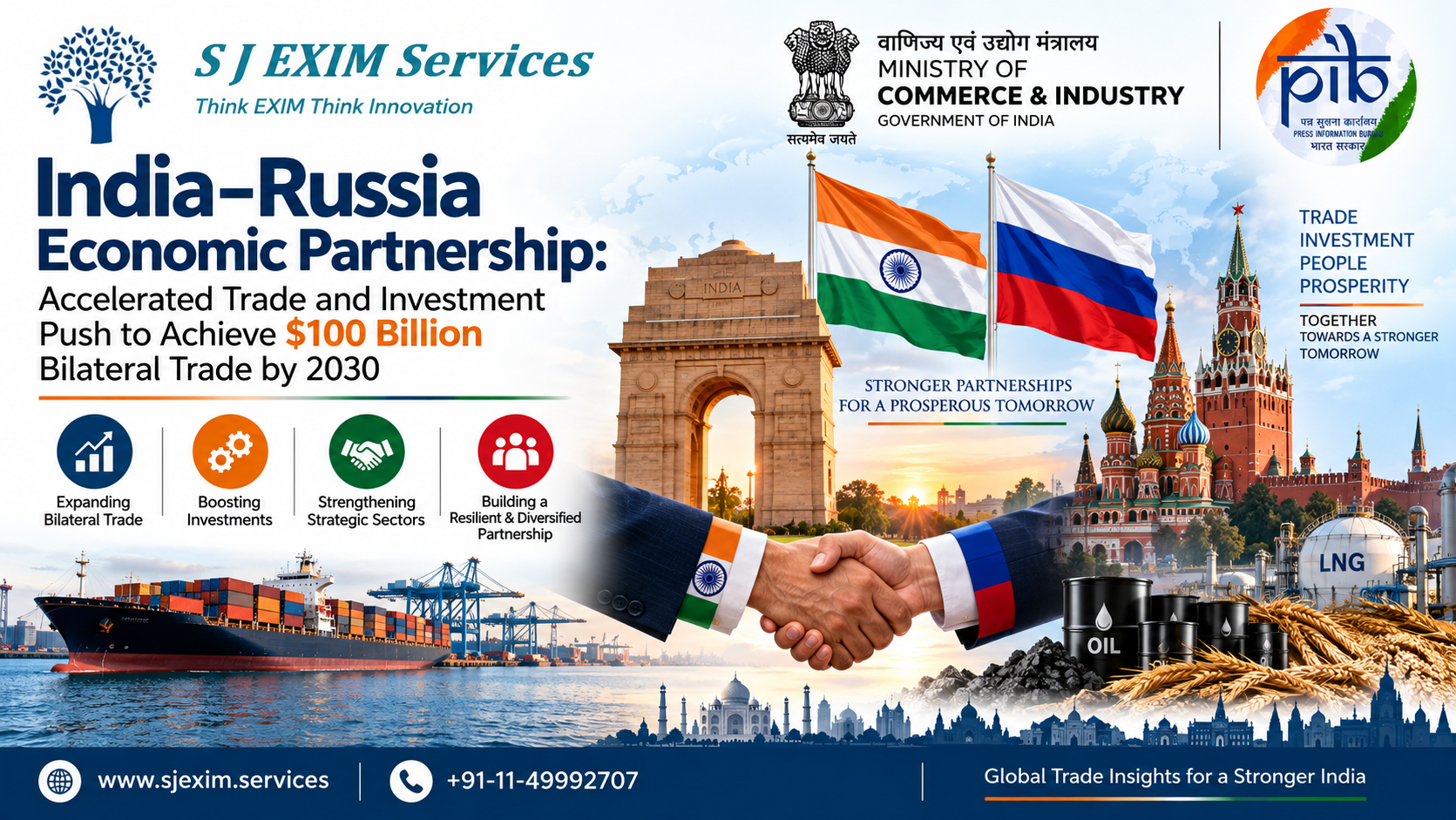
India–Russia Economic Partnership: Accelerated Trade and Investment Push to Achieve $100 Billion Bilateral Trade by 2030
India and Russia are looking to substantially deepen their economic and industrial partnership, with Union Commerce and Industry Minister Piyush Goyal calling on businesses from both countries to accelerate efforts towards achieving $100 billion in bilateral trade and $50 billion in two-way investment by 2030.
Addressing the IRIGC-TEC India 2026 Co-Chair Plenary Session in New Delhi alongside Russian Minister of Industry and Trade Anton Alikhanov, Goyal said the targets set by the leadership of the two countries should serve as a measure of performance not only for their governments but also for businesses on both sides.
The Minister’s remarks signal an effort to move the India–Russia relationship beyond its established areas of cooperation and towards a more diversified economic partnership involving pharmaceuticals, engineering, automobiles, food products, advanced manufacturing, technology and investment.
$100 Billion Bilateral Trade Target by 2030
- A central objective of the emerging economic partnership is to increase bilateral trade from its current base of around $70 billion to $100 billion by 2030.
- According to Goyal, achieving the target would require adding approximately $30 billion over the next four years and sustaining double-digit year-on-year growth. He stressed that this would require significant efforts from governments as well as private businesses in India and Russia.
- The target therefore represents more than a diplomatic aspiration—it requires the identification of new products, markets, investment opportunities and supply chains capable of broadening the existing commercial relationship.
India Seeks to Correct Trade Imbalance Through Higher Exports to Russia
- One of the most important aspects highlighted by Goyal was the need for greater balance in bilateral trade.
- While Russia is a significant supplier to India, India’s exports to the Russian market remain comparatively limited. Goyal identified this imbalance as an opportunity for Indian industry and called for expansion of exports in areas where India possesses established manufacturing and supply capabilities.
- The Minister specifically identified pharmaceuticals, auto components, tractors and food products among sectors offering significant potential for Indian exporters.
- The document further identifies pharmaceuticals, engineering goods, chemicals, textiles, food products, marine products and automotive products as sectors capable of contributing towards the bilateral trade target.
- For Indian exporters, this represents a significant opportunity to diversify beyond conventional markets and establish a stronger presence in Russia.
Food and Agricultural Exports Show Strong Growth
- Goyal highlighted recent growth in several Indian export categories as evidence of the scope for further diversification.
- Indian exports of meat and edible meat products increased from approximately $16 million to $61 million, representing growth of nearly 280%. Fish and aquatic-product exports increased from around $126 million to $176 million, while exports of edible vegetables rose from approximately $46 million to $69 million. Exports of coffee, tea and spices also recorded growth, while milling-industry products nearly doubled.
- These figures suggest that food and agricultural products could emerge as an important component of India’s strategy to expand and diversify exports to Russia.
$50 Billion Two-Way Investment Target
- Trade expansion is being accompanied by an equally ambitious investment agenda.
- The India–Russia priority investment projects mechanism is currently tracking approximately 40 active investment projects across sectors including advanced manufacturing, energy, mining, railways and emerging technologies.
- Goyal called upon Russia to provide greater opportunities for Indian investments in sectors such as pharmaceuticals, IT, artificial intelligence, services, engineering and railways, with the objective of making the proposed $50 billion investment target genuinely two-way.
- The emphasis on two-way investment is significant because it seeks to transform the commercial relationship from primarily trade-based transactions into deeper industrial and technological integration.
India Invites Russian Companies to ‘Make in India’
- Goyal also issued a direct invitation to Russian companies to manufacture in India rather than merely sell products into the Indian market.
- He highlighted India’s national industrial corridors as investment-ready destinations supported by plug-and-play infrastructure and emphasised the availability of India’s youthful talent pool and skilled workforce for Russian companies.
- The proposal effectively links the India–Russia economic partnership with India’s broader domestic manufacturing agenda, potentially enabling Russian businesses to use India not merely as a consumer market but also as a manufacturing and export base.
India–Eurasian Economic Union FTA Negotiations Gain Importance
- Another potentially significant development is progress towards a trade arrangement between India and the Eurasian Economic Union (EAEU), comprising Russia, Belarus, Kazakhstan, Armenia and the Kyrgyz Republic.
- According to the document, formal free-trade negotiations have already been launched, with India committed to concluding them early. The proposed arrangement is expected to open new markets for industries and particularly for MSMEs.
- If concluded, such an agreement could become an important structural mechanism for facilitating India’s trade not only with Russia but also with the wider Eurasian economic region.
- For exporters and importers, however, the actual commercial benefits will ultimately depend on the final tariff schedules, Rules of Origin, product-specific rules, customs procedures and other market-access commitments negotiated under the agreement.
Payment Frictions Continue to Affect Trade
- Despite the rapid growth in bilateral commerce, Goyal acknowledged that payment friction remains a practical challenge.
- He observed that payment-related difficulties often affect trade on the ground and said both countries continue to strengthen national and local-currency settlement mechanisms.
- Addressing payment and settlement issues will be particularly important if the countries intend to scale bilateral trade to $100 billion, because financial infrastructure and predictable settlement mechanisms are essential to supporting sustained cross-border transactions.
Connectivity: International North-South Transport Corridor and Chennai–Vladivostok Route
- Physical connectivity is another key pillar of the bilateral strategy.
- Goyal highlighted the International North-South Transport Corridor (INSTC) and the Chennai–Vladivostok maritime corridor, stressing that connectivity should become a practical instrument of trade policy rather than merely an infrastructure initiative.
- Improved logistics connectivity could reduce transportation bottlenecks and support greater movement of goods between India, Russia and the wider Eurasian region.
- For Indian exporters, the effectiveness of these corridors will ultimately be judged by commercial parameters such as transit times, freight costs, customs procedures, port connectivity and reliability.
Five Immediate Tasks Set for India–Russia Businesses
- Goyal also outlined a practical agenda for businesses and officials from both countries. He urged businesses to finalise at least one commercial deal before leaving Delhi, identify a new field and partner and advance at least one concrete project.
- He also called upon companies to add a new non-energy line to their trade and investment plans, particularly in pharmaceuticals, engineering goods, chemicals, auto components, tractors, textiles, food, agri-tech and marine products.
- The focus on non-energy trade is particularly important because diversification will be essential if the two countries intend to develop a more balanced and sustainable commercial relationship.
From Energy Trade to a Broader Industrial Partnership
- India–Russia economic relations have historically been associated strongly with strategic sectors. The latest policy direction, however, indicates a deliberate attempt to broaden the relationship into manufacturing, technology, pharmaceuticals, agriculture, food processing, engineering, logistics and investment.
- Goyal described the relationship as having considerable untapped potential and emphasised that India’s strengths in industrial manufacturing and investment, together with Russia’s engineering capabilities, could create a deeper and more balanced economic partnership.
- The presence of ABB, TMT India at the event was also highlighted as historically significant, with the company described as a platform through which Russian engineering and manufacturing had presented itself globally.
What It Means for Indian Businesses
- For Indian businesses, the evolving India–Russia economic partnership presents opportunities on three interconnected fronts: exports, investment and manufacturing collaboration.
- Exporters may find opportunities in pharmaceuticals, engineering goods, chemicals, textiles, automotive components, tractors, food, agricultural and marine products. Indian investors could potentially expand into Russian pharmaceuticals, IT, AI, services, engineering and railway sectors, while Russian businesses are being encouraged to establish manufacturing operations in India.
- At the policy level, the proposed India–EAEU trade agreement, improved payment mechanisms and new logistics corridors could collectively provide the institutional framework required to support this expansion.
- Importantly, however, the $100 billion trade and $50 billion investment figures are targets for 2030, rather than already achieved outcomes or legally binding commercial commitments.
Conclusion
The emerging India–Russia economic strategy reflects a clear shift towards a broader, more balanced and investment-driven partnership.
India’s immediate objective is not simply to increase the overall volume of bilateral trade, but to substantially expand Indian exports, attract Russian manufacturing investment, create two-way investment flows, resolve payment challenges and strengthen physical connectivity.
With a target of $100 billion in bilateral trade and $50 billion in two-way investment by 2030, the next phase of India–Russia economic relations is likely to depend heavily on businesses translating government-level commitments into actual investments, supply chains, export contracts and manufacturing partnerships.
In case you face any issues related to Indirect Tax-Customs, GST, Foreign Trade Policy (FTP), Arbitration matters and Central Licensing and related advisory matters in India then please feel free to get in touch with SJ EXIM Services.
We offer Legal advice and litigation support in matters related to Indirect Tax-Customs, FTP, other Indirect Tax matters & Arbitration law, all sorts of Central licensing and related matters. Come and explore the new way of doing business with us!
We specialize in paralegal services, litigation support, tax and regulatory matters, delivering reliable, efficient, and result-oriented legal assistance.
Source: Ministry of Commerce & Industry
Handy Download:
Connect with us for more-
@ Team S J EXIM SERVICES, New Delhi, IN
CP: Ms. Shubhra Jha, Founder
Tel: +91-11-4999 2707 I +91-9999005693
Web: www.sjexim.services
EMAIL: operations@sjexim.services I shubhra@sjexim.services
Facebook: www.facebook.com/sjeximservices
LinkedIn: https://www.linkedin.com/company/90794255/admin/feed/posts/
YouTube: https://www.youtube.com/@aadrikaalawindia
Subscribe our WhatsApp Channel: https://whatsapp.com/channel/0029VaTxDT8JZg4CHEOSoK47
Subscribe our Telegram Channel: https://t.me/sjeximindia





Leave a Reply