

“Indirect Tax I Indirect Tax Litigation I Customs & FTP I Central Licensing I Arbitration I Advisory”
Dated: 21.09.2026
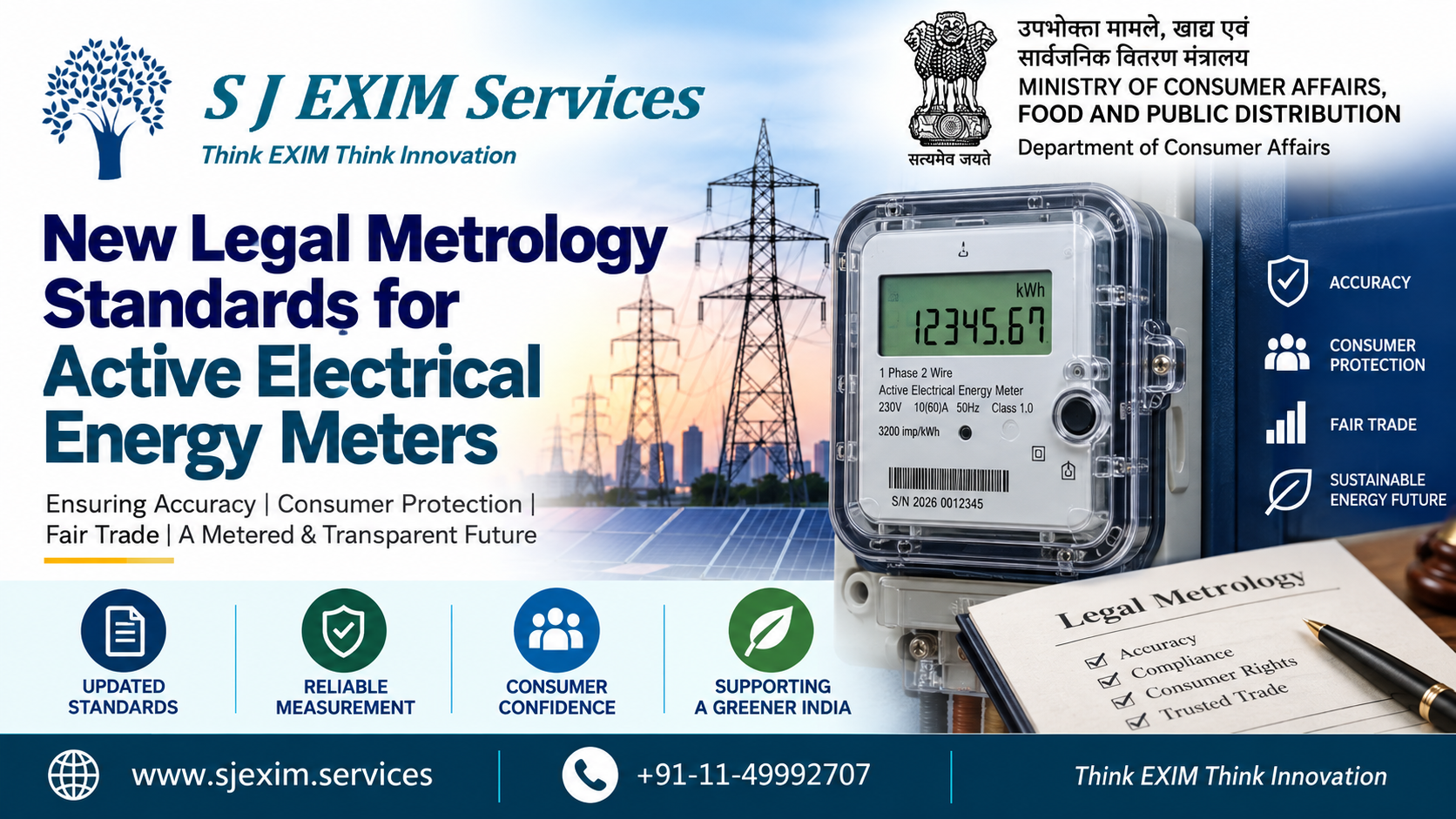
New Legal Metrology Standards for Active Electrical Energy Meters
The Ministry of Consumer Affairs, Food and Public Distribution, Department of Consumer Affairs, has notified the Legal Metrology (General) Fifth Amendment Rules, 2026, introducing an extensive new regulatory framework for Active Electrical Energy Meters under the Legal Metrology regime.
The amendment was notified through G.S.R. 809(E) dated September 15, 2026, in exercise of powers under Section 52 of the Legal Metrology Act, 2009. The Rules will come into force 180 days after their publication in the Official Gazette.
The amendment inserts a new Part XIV – “Active Electrical Energy Meters” into the Eighth Schedule of the Legal Metrology (General) Rules, 2011, establishing detailed metrological, technical, testing, type-approval, software-security and verification requirements for electricity meters.
New Part XIV Introduced for Active Electrical Energy Meters
- Under Rule 2 of the amendment, a new Part XIV has been inserted after Part XIII in the Eighth Schedule of the Legal Metrology (General) Rules, 2011.
- Part XIV begins with “Active Electrical Energy Meters – Part 1: Metrological and Technical Requirements.”
- The framework is considerably detailed, running through technical definitions, permissible errors, environmental and operating conditions, construction and software requirements, performance testing, type approval and verification.
- An “electricity meter” is defined as an instrument intended to continuously measure electrical energy by integrating power with respect to time and storing the result. The Rules separately recognise various types of meters, including interval meters, prepayment meters, multi-tariff/multi-rate meters, direct-connected meters, transformer-operated meters, electromechanical meters and static meters.
Metrological Requirements Standardised
- The new regime prescribes detailed metrological characteristics for electricity meters.
- These include requirements concerning current, starting current, minimum current, transitional current, maximum current, voltage, nominal voltage, frequency, nominal frequency, harmonics, distortion factor, power factor, active power, active energy and maximum permissible error.
The Rules prescribe the permissible units for measuring active electrical energy as:
Wh, kWh, MWh and GWh.
This creates a comprehensive statutory measurement framework for active electrical energy meters under the Legal Metrology Rules.
Accuracy Classes Introduced
- Manufacturers are required to specify the accuracy class of a meter.
- The notification divides meters into specified accuracy classes and prescribes maximum permissible error limits for each class under different combinations of current and power factor.
- The Rules require meters to be designed and manufactured so that, under their rated operating conditions, their errors remain within the prescribed maximum permissible limits. They must also be designed so that exposure to external disturbances does not result in significant faults.
- Notably, the notification states that for larger consumers—where consumption exceeds 5,000 kWh per year—the prescribed Class B is the lowest accuracy class permitted.
Rules Cover Both Unidirectional and Bidirectional Energy Flow
- The amendment expressly addresses meters capable of measuring electricity flowing in different directions.
- Where a manufacturer specifies that a meter is capable of bidirectional energy flow, the meter must correctly handle both positive and negative average energy flows and comply with the prescribed requirements in both directions.
- The notification recognises configurations including single-register bidirectional meters, two-register bidirectional meters, positive-direction-only meters and unidirectional meters.
- This aspect is particularly relevant to modern electricity systems where meters may need to account for electricity moving both to and from consumers.
Operating Conditions Prescribed for Electricity Meters
The amendment also specifies rated operating conditions covering factors such as:
- frequency, voltage, current, power factor, temperature, humidity, water exposure, connection type, mounting position, harmonics and load balance.
- For voltage, for example, the prescribed operating condition generally covers Unom ±10%, while nominal frequency is subject to a specified ±2% operating range.
- Manufacturers must also specify whether a meter is intended for direct connection, use through current transformers, or through current and voltage transformers.
Environmental and Electromagnetic Performance Also Regulated
- The new framework does not limit compliance to basic measurement accuracy.
- Meters are required to perform within specified limits despite various external influences and disturbances. The notification contains detailed test requirements concerning matters such as voltage variations, frequency variations, harmonics in voltage and current circuits, phase interruption, sub-harmonics, reversed phase sequence, external magnetic fields, radio-frequency electromagnetic fields and conducted disturbances.
- This significantly expands the technical depth of the Legal Metrology framework applicable to electricity meters.
Type Approval Becomes a Key Compliance Requirement
Part 2 of the new framework deals with “Metrological Controls and Performance Tests.”
For type approval, manufacturers are required to submit documentation identifying the meter type and providing relevant technical and metrological information.
The documentation includes, among other things:
- name/trademark and type designation;
- hardware and software versions;
- nameplate drawing;
- measurement principles;
- accuracy class and rated operating conditions;
- technical specifications and functional block diagrams;
- construction and operation information;
- seals and other protection mechanisms; and
- durability-related documentation.
The type-evaluation process is intended to determine whether the meter satisfies the prescribed metrological and technical requirements and whether the manufacturer’s documentation satisfies the regulatory requirements.
A meter may be treated as having passed the type-approval examination only where the applicable type-test results comply with the prescribed requirements.
Software and Digital Integrity Form Part of Legal Metrology Compliance
- A particularly important feature of the 2026 amendment is its treatment of software-controlled electricity meters.
- The notification goes beyond conventional mechanical and metrological testing and contains requirements directed at software, data integrity, legally relevant parameters, unauthorised modification and auditability.
- The framework contemplates methods including functional testing of software functions, metrological data-flow analysis, and code inspection/walk-through where enhanced examination is required.
- This reflects the increasing use of static, digital and software-controlled meters and brings the Legal Metrology framework closer to the technological architecture of modern electricity metering systems.
Verification and Re-Verification Requirements
- The amendment also creates detailed requirements for verification of meters.
- Initial verification is required for meters, while meters that have been repaired or otherwise altered are subject to re-verification in accordance with the prescribed framework.
- The notification additionally prescribes re-verification periods for specified categories of in-service meters, with separate requirements depending upon the type and configuration of the meter.
- Accordingly, compliance will not necessarily end with type approval. The regulatory framework extends into the operational life of the meter through verification, re-verification and in-service metrological controls.
Why the Amendment Is Important for Manufacturers and Importers
- The amendment has potentially significant compliance implications for businesses engaged in the manufacture, import, testing, supply and distribution of electricity meters in India.
- The new Part XIV establishes technical requirements that extend across the complete compliance architecture of a meter—from its design and measurement characteristics to environmental resistance, software integrity, type evaluation and subsequent verification.
- Manufacturers and importers dealing in active electrical energy meters should therefore review product specifications against the new Part XIV well before the Rules become operational.
- In particular, businesses may need to assess whether existing meter models, technical documentation, software architecture, testing protocols, nameplates, protection mechanisms and type-approval documentation conform to the newly prescribed requirements.
180-Day Transition Period
- The Central Government has expressly provided that the amendment will come into force 180 days from the date of publication in the Official Gazette, rather than immediately.
- This transition period is commercially significant because the amendment introduces a detailed technical regime rather than a limited procedural modification.
- Manufacturers, importers, electricity-meter suppliers and testing entities should therefore use the transition period to undertake product-level compliance reviews and determine the type-approval and verification requirements applicable to their meter portfolios.
Statutory Basis
- The notification has been issued by the Central Government by exercising powers under Section 52(1), read with clauses (c), (f), (h), (i) and (s) of Section 52(2) of the Legal Metrology Act, 2009.
- The amendment modifies the Legal Metrology (General) Rules, 2011, whose principal notification was G.S.R. 71(E) dated February 7, 2011.
Key Takeaway
The Legal Metrology (General) Fifth Amendment Rules, 2026 establish a substantially expanded compliance framework for active electrical energy meters in India.
The notification is important not merely because it prescribes accuracy requirements, but because it creates an integrated regime covering meter design, operating conditions, permissible errors, environmental and electromagnetic performance, software integrity, type evaluation, approval, initial verification and re-verification.
With the Rules scheduled to become effective after the stipulated 180-day transition period, manufacturers, importers and other stakeholders dealing with electricity meters have a defined window to assess their existing products and compliance systems against the new Part XIV requirements.
In case you face any issues related to Indirect Tax-Customs, GST, Foreign Trade Policy (FTP), Arbitration matters and Central Licensing and related advisory matters in India then please feel free to get in touch with SJ EXIM Services.
We offer Legal advice and litigation support in matters related to Indirect Tax-Customs, FTP, other Indirect Tax matters & Arbitration law, all sorts of Central licensing and related matters. Come and explore the new way of doing business with us!
We specialize in paralegal services, litigation support, tax and regulatory matters, delivering reliable, efficient, and result-oriented legal assistance.
Source: Ministry of Consumer Affairs, Food and Public Distribution
Handy Download:
Connect with us for more-
@ Team S J EXIM SERVICES, New Delhi, IN
CP: Ms. Shubhra Jha, Founder
Tel: +91-11-4999 2707 I +91-9999005693
Web: www.sjexim.services
EMAIL: operations@sjexim.services I shubhra@sjexim.services
Facebook: www.facebook.com/sjeximservices
LinkedIn: https://www.linkedin.com/company/90794255/admin/feed/posts/
YouTube: https://www.youtube.com/@aadrikaalawindia
Subscribe our WhatsApp Channel: https://whatsapp.com/channel/0029VaTxDT8JZg4CHEOSoK47
Subscribe our Telegram Channel: https://t.me/sjeximindia








Leave a Reply