

“Indirect Tax I Indirect Tax Litigation I Customs & FTP I Central Licensing I Arbitration I Advisory”
Dated: 13.10.2026
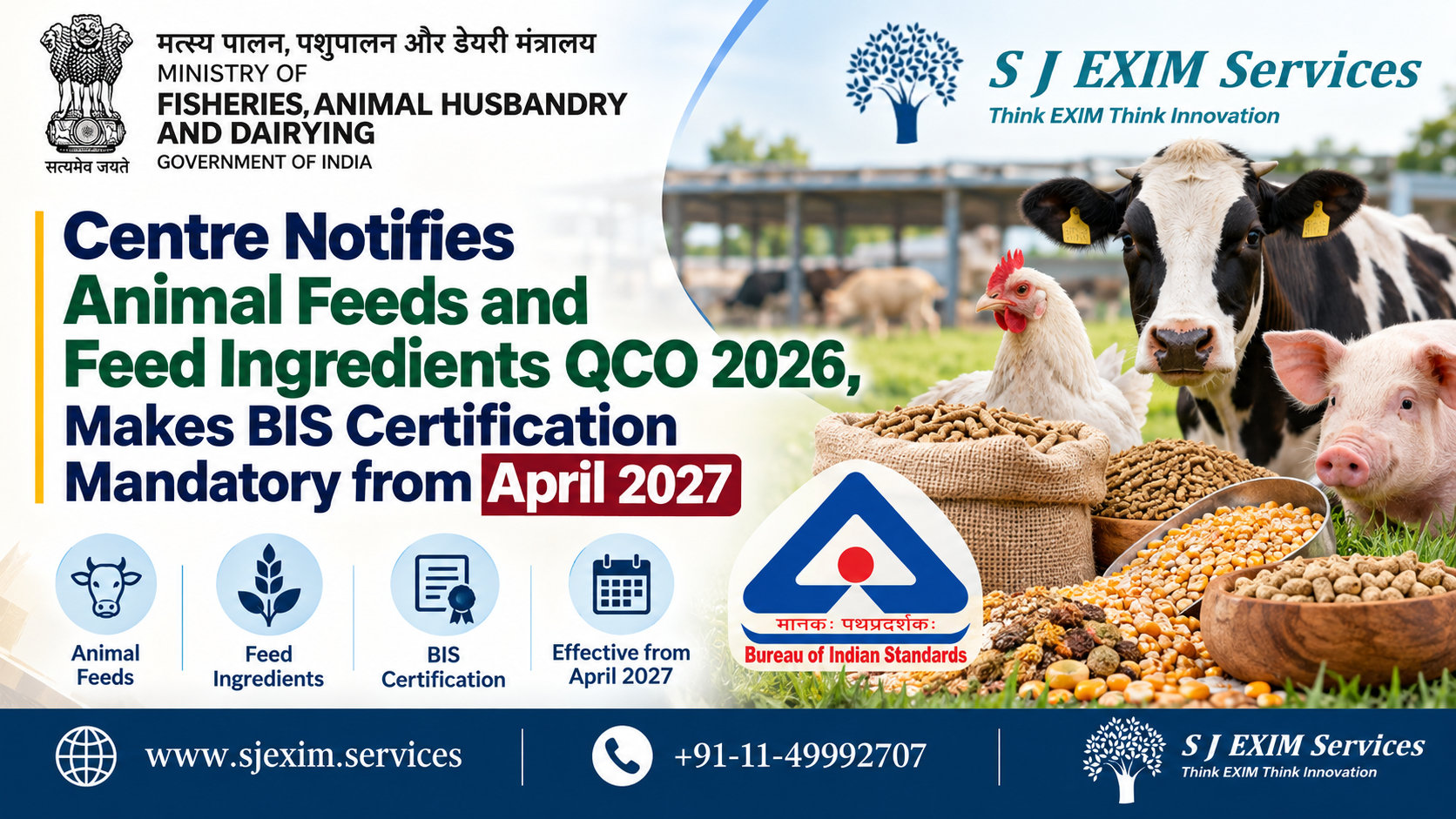
Centre Notifies Animal Feeds and Feed Ingredients QCO 2026, Makes BIS Certification Mandatory from April 2027
The Government of India, through the Ministry of Fisheries, Animal Husbandry and Dairying, Department of Animal Husbandry and Dairying, has notified the Animal Feeds and Feed Ingredients (Quality Control) Order, 2026, introducing mandatory Bureau of Indian Standards (BIS) certification requirements for specified animal feed ingredients and supplements.
The Order has been issued under Section 16 of the Bureau of Indian Standards Act, 2016, following consultation with the Bureau of Indian Standards and in consideration of public interest.
The notification was issued on 7 October 2026 and published in the Gazette of India on 12 October 2026.
The new regulatory framework covers three specified product categories: mineral mixtures for supplementing cattle feeds, dicalcium phosphate of animal feed grade, and common salt and cattle licks intended for animal consumption.
The Order requires these products to conform to their corresponding Indian Standards and bear the BIS Standard Mark under a valid licence issued in accordance with Scheme-I of Schedule-II to the Bureau of Indian Standards (Conformity Assessment) Regulations, 2018.
Importantly, the Government has prescribed staggered implementation dates for general enterprises, small enterprises and micro enterprises.
The development has significant implications for domestic manufacturers, importers, foreign manufacturers, animal nutrition companies, livestock feed suppliers and businesses engaged in the procurement or distribution of the notified products.
1. Statutory Authority and Notification Details
- The Animal Feeds and Feed Ingredients (Quality Control) Order, 2026 has been issued under the statutory authority conferred upon the Central Government by Section 16 of the Bureau of Indian Standards Act, 2016.
- Section 16 empowers the Central Government, subject to the statutory conditions, to require specified goods or articles to conform to Indian Standards and bear the Standard Mark.
- The notification expressly records that the Government consulted BIS before issuing the Order.
Notification at a Glance
| Particulars | Details |
| Issuing Ministry | Ministry of Fisheries, Animal Husbandry and Dairying |
| Department | Department of Animal Husbandry and Dairying |
| Notification Number | S.O. 5576(E) |
| Notification Date | 7 October 2026 |
| Gazette Publication Date | 12 October 2026 |
| Name of Order | Animal Feeds and Feed Ingredients (Quality Control) Order, 2026 |
| Enabling Provision | Section 16, BIS Act, 2016 |
| Certification Scheme | Scheme-I, Schedule-II, BIS (Conformity Assessment) Regulations, 2018 |
| Certification and Enforcement Authority | Bureau of Indian Standards |
| First Mandatory Compliance Date | 1 April 2027 |
- The Order comes into force on its publication in the Official Gazette.
- However, the actual dates from which the prescribed Indian Standards become mandatory for different categories of enterprises are separately specified in the notification’s Schedule.
- This distinction between the commencement of the Order and the implementation of mandatory product conformity requirements is particularly important for compliance planning.
2. Products Covered Under the Animal Feeds and Feed Ingredients QCO, 2026
The notification specifies three categories of goods or articles for mandatory BIS conformity assessment.
Complete List of Products and Indian Standards
| S. No. | Goods or Articles | Applicable Indian Standard | Description of Standard |
| 1 | Mineral mixtures for supplementing cattle feeds | IS 1664 | Mineral mixtures for supplementing cattle feeds — Specification |
| 2 | Dicalcium phosphate, animal feed grade | IS 5470 | Dicalcium Phosphate, animal feed grade — Specification |
| 3 | Common salt and cattle licks for animal consumption | IS 920 | Specification for common salt and cattle licks for animal consumption |
The notification also clarifies that the latest versions of the Indian Standards, including amendments notified by BIS from time to time, will apply.
Therefore, manufacturers and importers should not rely exclusively on earlier editions of the standards when undertaking conformity assessment.
Product Coverage Requires Technical Examination
- The Order identifies covered goods by product descriptions and applicable Indian Standards.
- It does not provide a separate HSN-wise classification schedule.
- Consequently, the determination of QCO applicability should be based primarily on the technical nature, composition, specifications and intended use of the product.
- For imported goods, the applicable Customs tariff classification and BIS conformity requirements should be examined as separate regulatory questions.
3. Phased Implementation: General Enterprises, Small Enterprises and Micro Enterprises
The Government has introduced differentiated implementation dates to provide additional compliance time to micro and small enterprises.
Mandatory BIS Compliance Timeline
| Category of Enterprise | Implementation Date |
| General enterprises, other than micro and small enterprises | 1 April 2027 |
| Small enterprises | 1 July 2027 |
| Micro enterprises | 1 October 2027 |
- These implementation dates apply to all three product categories specified in the notification.
- The extended timelines are linked to the definitions of micro and small enterprises under the Micro, Small and Medium Enterprises Development Act, 2006.
Implications for MSMEs
- Small enterprises have been granted an additional three months compared with the general implementation date.
- Micro enterprises have been granted an additional six months.
- However, the notification does not prescribe a separate extended deadline for medium enterprises.
- Accordingly, medium enterprises should not automatically assume that the concessions applicable to micro and small enterprises are available to them.
- Businesses seeking to rely on the extended deadlines should verify their enterprise classification and maintain supporting documentation.
4. Mandatory BIS Standard Mark and Licensing Requirements
Clause 2 of the Order establishes the principal regulatory obligation.
The notified goods or articles must:
- Conform to the corresponding Indian Standard specified in the Schedule.
- Bear the BIS Standard Mark.
- Be covered by a licence issued by BIS under Scheme-I of Schedule-II to the BIS (Conformity Assessment) Regulations, 2018.
The notification therefore introduces a mandatory licensing and marking requirement, rather than merely recommending voluntary adherence to technical standards.
Technical Compliance Is Not the Same as BIS Licensing
- An important distinction must be maintained between a product satisfying the technical parameters of an Indian Standard and the manufacturer holding a valid BIS licence permitting use of the Standard Mark.
- Where the QCO applies, product conformity alone does not replace the certification and marking requirements expressly prescribed by the Order.
- Manufacturers should therefore review their existing BIS certification status and determine whether the relevant product and manufacturing premises are covered by an appropriate licence.
5. Exemption for Goods Intended for Export
- The notification expressly provides that the Order shall not apply to goods or articles meant for export.
- This exemption recognises that products manufactured or supplied for export markets may be subject to different technical specifications or regulatory requirements.
- However, the exemption should be interpreted in accordance with the wording of the notification.
- Businesses should maintain appropriate documentary evidence demonstrating that the relevant goods are genuinely intended for export.
- The notification does not prescribe a separate exemption for all imported goods or for goods supplied for domestic consumption merely because the manufacturer is export-oriented.
6. Implications for Importers and Foreign Manufacturers
- The introduction of mandatory BIS certification requirements may have important consequences for businesses importing the notified animal feed ingredients into India.
- Although the Order does not separately describe Customs clearance procedures, its mandatory conformity and Standard Mark requirements are relevant to import compliance once the applicable implementation date is reached.
- Importers should examine whether the imported goods fall within the scope of IS 1664, IS 5470 or IS 920.
Key Compliance Questions for Importers
Importers should evaluate the following:
- Whether the imported product is covered by one of the three notified Indian Standards.
- Whether the foreign manufacturing facility possesses the required BIS certification.
- Whether the product is eligible to bear the BIS Standard Mark under the applicable licensing framework.
- Whether the product specifications match the relevant Indian Standard.
- Whether the applicable implementation date has commenced.
- Whether an express exemption under the notification is available.
Foreign Manufacturers Certification
- Foreign manufacturers supplying covered goods to India should assess the relevant BIS certification route, including the Foreign Manufacturers Certification Scheme where applicable.
- The notification itself does not provide detailed procedures for foreign manufacturer certification.
- Such procedures must be examined under the applicable BIS regulatory framework.
HSN Classification and QCO Applicability
- A product’s Customs tariff heading should not be treated as the sole determinant of QCO applicability.
- For example, products containing calcium phosphate or mineral mixtures may require careful examination of their composition, intended use and the scope of the relevant Indian Standard.
A proper assessment should distinguish between:
- Customs classification under the Customs Tariff Act.
- Import policy under the Foreign Trade Policy.
- Product coverage under the notified QCO.
- BIS licensing and conformity assessment requirements.
These regulatory requirements may operate concurrently and should be assessed independently.
7. Implications for Domestic Animal Feed Manufacturers
- Manufacturers engaged in the production of cattle feed supplements, mineral mixtures, dicalcium phosphate and animal-consumption salt products should undertake a product-wise compliance assessment.
- Particular attention should be given to manufacturers producing multiple formulations or grades of feed ingredients.
- Not every product marketed under a broad description such as animal nutrition supplement or feed additive can automatically be assumed to fall within the QCO.
- The applicable standard and product specifications must be examined carefully.
Recommended Manufacturing Compliance Measures
Manufacturers should consider:
- Product identification: Determine which manufactured products correspond to the notified Indian Standards.
- Technical gap assessment: Compare product specifications and manufacturing processes with the applicable Indian Standard.
- Testing arrangements: Evaluate whether the required testing and quality control arrangements are available.
- BIS licensing: Review existing licences or initiate the appropriate application process.
- Supplier verification: Ensure that critical inputs and finished products meet the applicable technical requirements.
- Labelling and marking: Establish controls for lawful use of the BIS Standard Mark.
- Implementation planning: Complete certification preparations before the relevant statutory deadline.
8. Certification and Enforcement Authority
- Clause 3 expressly designates the Bureau of Indian Standards as the certification and enforcement authority for the goods or articles specified in the Schedule.
- Accordingly, BIS is the designated authority for implementing the certification and enforcement requirements contemplated by the Order.
- Manufacturers and other stakeholders should refer to applicable BIS procedures for matters relating to licence applications, conformity assessment, inspection, testing and certification.
- The notification does not create a separate certification authority within the Department of Animal Husbandry and Dairying.
9. Penalties for Contravention
- Clause 4 of the Order provides that any person contravening its provisions shall be punishable under the Bureau of Indian Standards Act, 2016.
- The Order itself does not prescribe a standalone monetary penalty or a separate schedule of offences.
- Instead, contraventions are governed by the applicable provisions of the BIS Act.
- The nature of any enforcement action or penalty will depend on the relevant statutory provision and the facts of the alleged contravention.
- Businesses should therefore treat the notification as a mandatory regulatory requirement once the relevant implementation date becomes applicable.
10. Regulatory Significance for the Animal Feed Industry
- The notification represents an important development in the regulatory treatment of specified animal feed ingredients and supplements.
- Its significance extends beyond BIS certification alone.
- The Order establishes a uniform set of notified Indian Standards for the covered goods and introduces a mandatory licensing framework for their supply in the Indian market.
- For domestic manufacturers, this creates a need to review technical conformity, quality assurance processes and certification arrangements.
- For importers and foreign suppliers, the notification makes early identification of covered products and certification readiness particularly important.
- For micro and small enterprises, the staggered implementation dates provide additional time to prepare for compliance.
- The notification does not, however, impose mandatory BIS certification on every category of animal feed or animal feed ingredient.
- Its scope is limited to the three product categories identified in the Schedule.
11. Practical Compliance Roadmap for Industry Stakeholders
Businesses dealing in the notified products should adopt a structured approach.
Step 1 — Identify covered products
- Prepare a product inventory and identify all goods potentially covered by IS 1664, IS 5470 and IS 920.
Step 2 — Verify applicable standards
- Obtain and review the current versions of the notified Indian Standards, including applicable amendments.
Step 3 — Determine enterprise classification
- Confirm whether the business falls within the general, small enterprise or micro enterprise category for implementation purposes.
Step 4 — Review certification status
- Verify whether the relevant manufacturing facility and products are covered by an appropriate BIS licence.
Step 5 — Evaluate imported products
- For overseas supplies, confirm the manufacturer’s certification arrangements and assess potential import compliance implications.
Step 6 — Prepare compliance documentation
- Maintain appropriate records relating to product specifications, certification, manufacturing, testing and Standard Mark use.
Step 7 — Monitor subsequent developments
- Track any amendments, clarifications or further notifications issued by the Government or BIS.
12. Key Legal and Regulatory Takeaways
The principal features of the Animal Feeds and Feed Ingredients (Quality Control) Order, 2026 are as follows:
- The Order has been notified under Section 16 of the BIS Act, 2016.
- It was issued on 7 October 2026 and published on 12 October 2026.
- It covers three specified categories of animal feed ingredients and supplements.
- The applicable Indian Standards are IS 1664, IS 5470 and IS 920.
- Mandatory conformity and BIS Standard Mark requirements apply under Scheme-I licensing.
- General enterprises must comply from 1 April 2027.
- Small enterprises must comply from 1 July 2027.
- Micro enterprises must comply from 1 October 2027.
- Goods or articles meant for export are exempt.
- BIS is the designated certification and enforcement authority.
- Contraventions are punishable under the BIS Act, 2016.
Conclusion
The Animal Feeds and Feed Ingredients (Quality Control) Order, 2026 introduces a revised mandatory conformity assessment framework for specified products used in animal nutrition and livestock feeding.
The notification establishes clear product coverage, identifies the applicable Indian Standards and prescribes phased implementation dates for different categories of enterprises.
Manufacturers, importers and foreign suppliers should use the transition period to examine product applicability, review technical specifications and make appropriate BIS licensing arrangements.
Early regulatory assessment will be especially important for businesses handling mineral mixtures for cattle feed, animal feed-grade dicalcium phosphate and common salt or cattle licks intended for animal consumption.
The Order is a significant compliance development for the affected segments of the animal feed industry, but its requirements must be interpreted according to the specific products and standards expressly notified.
In case you face any issues related to Indirect Tax-Customs, GST, Foreign Trade Policy (FTP), Arbitration matters and Central Licensing and related advisory matters in India then please feel free to get in touch with SJ EXIM Services.
We offer Legal advice and litigation support in matters related to Indirect Tax-Customs, FTP, other Indirect Tax matters & Arbitration law, all sorts of Central licensing and related matters. Come and explore the new way of doing business with us!
We specialize in paralegal services, litigation support, tax and regulatory matters, delivering reliable, efficient, and result-oriented legal assistance.
Source: Ministry of Fisheries, Animal Husbandry and Dairying
Handy Download:
Connect with us for more-
@ Team S J EXIM SERVICES, New Delhi, IN
CP: Ms. Shubhra Jha, Founder
Tel: +91-11-4999 2707 I +91-9999005693
Web: www.sjexim.services
EMAIL: operations@sjexim.services I shubhra@sjexim.services
Facebook: www.facebook.com/sjeximservices
LinkedIn: https://www.linkedin.com/company/90794255/admin/feed/posts/
YouTube: https://www.youtube.com/@aadrikaalawindia
Subscribe our WhatsApp Channel: https://whatsapp.com/channel/0029VaTxDT8JZg4CHEOSoK47
Subscribe our Telegram Channel: https://t.me/sjeximindia







Leave a Reply