

“Indirect Tax I Indirect Tax Litigation I Customs & FTP I Central Licensing I Arbitration I Advisory”
Dated: 12.10.2026
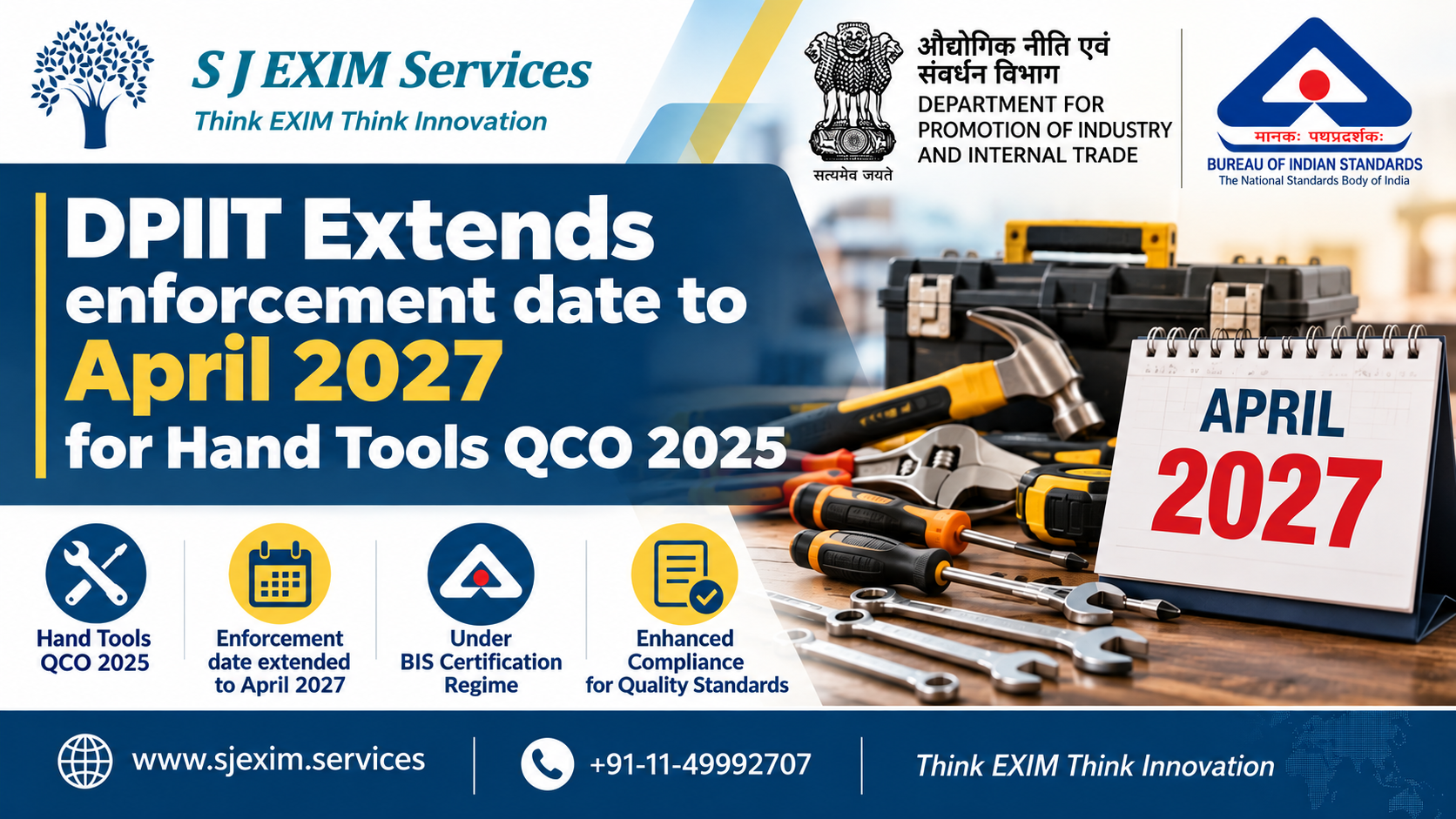
DPIIT Extends enforcement date to April 2027 for Hand Tools QCO 2025
The Ministry of Commerce and Industry, Government of India, through the Department for Promotion of Industry and Internal Trade (DPIIT), has notified the Hand Tools (Quality Control) Order, 2026, introducing revised mandatory quality certification requirements for specified hand tools.
The Order was published in the Gazette of India on 9 October 2026 under Notification S.O. 5561(E), in exercise of powers conferred by Section 16 of the Bureau of Indian Standards Act, 2016.
The notification supersedes the Hand Tools (Quality Control) Order, 2025, while preserving actions taken or omitted before such supersession.
Under the revised regulatory framework, covered hand tools must conform to the applicable Indian Standards and bear the BIS Standard Mark under a valid licence issued in accordance with Scheme-I of Schedule-II to the Bureau of Indian Standards (Conformity Assessment) Regulations, 2018.
The Order establishes phased compliance deadlines for general enterprises, small enterprises and micro enterprises, beginning on 1 April 2027.
The development is relevant to manufacturers, importers, foreign suppliers, distributors and industrial users dealing in hand tools in the Indian market.
1. Statutory Authority and Notification Details
- The Central Government has issued the Order under Section 16 of the Bureau of Indian Standards Act, 2016, following consultation with the Bureau of Indian Standards.
- The notification records the Government’s opinion that compulsory conformity assessment is necessary or expedient in the public interest.
Notification particulars
| Particular | Details |
| Issuing Ministry | Ministry of Commerce and Industry |
| Department | Department for Promotion of Industry and Internal Trade (DPIIT) |
| Notification | S.O. 5561(E) |
| Date of Notification | 9 October 2026 |
| Title | Hand Tools (Quality Control) Order, 2026 |
| Enabling Provision | Section 16, BIS Act, 2016 |
| Previous Order | Hand Tools (Quality Control) Order, 2025 |
| Certification Scheme | Scheme-I, Schedule-II, BIS (Conformity Assessment) Regulations, 2018 |
| Certification and Enforcement Authority | Bureau of Indian Standards |
Although the Order comes into force upon publication in the Official Gazette, the mandatory conformity dates for the listed products are separately prescribed in the Schedule.
Accordingly, the notification’s commencement date must be distinguished from the product-specific implementation deadlines.
2. Products Covered Under the Hand Tools QCO, 2026
- The notification covers nine Indian Standards relating to different categories of hand tools.
- These include pipe wrenches, open-jaw spanners, ring spanners, adjustable wrenches, slugging wrenches and combination side-cutting pliers.
Complete List of Notified Indian Standards
| S. No. | Indian Standard | Product Description |
| 1 | IS 4003 (Part 1):2026 | Pipe Wrenches — Specification, Part 1: General Purpose |
| 2 | IS 4003 (Part 2):2026 | Pipe Wrenches — Specification, Part 2: General Purpose |
| 3 | IS 2028:2026 | Open Jaw Wrenches (Spanners) |
| 4 | IS 2029:2026 | Ring Wrenches (Spanners) |
| 5 | IS 6149:2025 | Single Ended Open-Jaw Adjustable Wrenches — Specification |
| 6 | IS 4123:2024 | Chain Pipe Wrenches — Specification |
| 7 | IS 4508:2024 | Open-Ended Slugging Wrenches (Spanners) |
| 8 | IS 4509:2024 | Ring Slugging Wrenches (Spanners) |
| 9 | IS 3650:2026 | Specification for Combination Side-Cutting Pliers |
The notification further specifies that the latest versions of the Indian Standards, including amendments notified by BIS from time to time, will apply.
Consequently, businesses should verify not only the relevant standard number but also its applicable edition and subsequent amendments.
3. Implementation Dates: General, Small and Micro Enterprises
The Government has adopted a phased implementation mechanism.
| Enterprise Category | Mandatory Compliance Date |
| General enterprises, other than micro and small enterprises | 1 April 2027 |
| Small enterprises | 1 July 2027 |
| Micro enterprises | 1 October 2027 |
- The dates apply to all nine Indian Standards listed in the notification.
- The additional time available to small and micro enterprises is expressly linked to their classification under the Micro, Small and Medium Enterprises Development Act, 2006.
- The notification does not create a separate deferred implementation date for medium enterprises.
- Therefore, medium enterprises should not assume that the extended dates available to micro and small enterprises automatically apply to them.
4. Mandatory BIS Certification and Standard Mark
- Clause 2 of the Order requires the specified goods or articles to conform to the corresponding Indian Standards.
- The products must also bear the BIS Standard Mark under a licence issued by the Bureau in accordance with Scheme-I of Schedule-II to the BIS (Conformity Assessment) Regulations, 2018.
- This is significant because the requirement is not limited to technical conformity with an Indian Standard.
- The Order expressly requires the use of the Standard Mark under a BIS licence.
Manufacturers and suppliers should therefore distinguish between:
- Compliance with the technical requirements of the applicable Indian Standard.
- Successful completion of the relevant conformity assessment and licensing process.
- Lawful application of the BIS Standard Mark to covered products.
A product’s technical conformity alone should not be treated as equivalent to possession of the licence required by the QCO.
5. Exemption for Goods Manufactured Domestically for Export
- The notification expressly excludes goods or articles manufactured domestically for export.
- This exemption recognises that goods manufactured in India exclusively for export may be intended to comply with specifications required by foreign markets.
- However, the exemption is expressly framed around goods manufactured domestically for export.
- Businesses should not interpret it as a general exemption for imported hand tools or for products intended for sale in the Indian domestic market.
- Manufacturers relying on this exemption should maintain appropriate records establishing the export-oriented nature of the relevant goods.
6. Research and Development Exemption: 200 Imported Articles Per Year
- The Hand Tools QCO, 2026 also provides a specific exemption for imported goods or articles used for research and development.
- The exemption is available for up to 200 articles per year imported by manufacturers of hand tools for research and development purposes.
The notification attaches important conditions:
- The imported goods must be used for research and development.
- The annual quantity is restricted to 200 articles.
- The imported goods must not be sold commercially.
- The goods must be disposed of as scrap.
- Manufacturers must maintain year-wise records.
- Such records must be furnished when required by a Government authority.
- This exemption is not a general relaxation for sample imports or commercial trial shipments.
- It is a conditional exemption requiring documentary control and compliance with the specified end-use and disposal requirements.
- Importers and manufacturers intending to claim this benefit should ensure that their import documentation, internal inventory records and disposal records are consistent with the notification.
7. Implications for Importers and Foreign Manufacturers
- The Order has important implications for international suppliers and Indian importers dealing in the notified hand tools.
- The notification does not prescribe a separate import-specific implementation date.
- Accordingly, importers should plan their procurement and compliance arrangements around the relevant implementation dates and applicable BIS licensing requirements.
- Foreign manufacturers supplying covered hand tools to India may need to evaluate the appropriate BIS licensing route, including the Foreign Manufacturers Certification Scheme where applicable.
Importers should examine:
- Whether the imported article falls within the product scope of one of the nine notified Indian Standards.
- Whether the overseas manufacturing facility holds the required BIS licence.
- Whether the product bears the appropriate Standard Mark.
- Whether any exemption expressly provided under the Order applies.
- Whether the product description, technical specifications and intended use are consistent with the applicable standard.
Importance of Product-Specific Assessment
- The QCO identifies products through descriptions and Indian Standards rather than through an HSN-wise schedule.
- Consequently, customs tariff classification and BIS product coverage should be assessed separately.
- An HSN classification alone should not be treated as conclusive proof that a product is covered by, or excluded from, the QCO.
- For products having specialised designs or industrial applications, the precise technical scope of the relevant Indian Standard should be examined before determining applicability.
8. Compliance Responsibilities of Domestic Manufacturers
- Domestic manufacturers of covered hand tools should initiate preparations well before the applicable deadline.
- A practical compliance review should cover product identification, applicable Indian Standards, manufacturing processes, testing capabilities, quality control systems and BIS licensing requirements.
- Where a manufacturer produces multiple types of wrenches, spanners or pliers, each product category should be mapped to the relevant notified standard.
- Manufacturers should also review whether their existing product specifications comply with the revised editions of the Indian Standards identified in the notification.
- The inclusion of updated 2024, 2025 and 2026 editions makes it important to verify current technical requirements rather than relying solely on older specifications.
9. Role of the Bureau of Indian Standards
- Clause 3 of the Order designates the Bureau of Indian Standards as the certification and enforcement authority for the covered goods.
- BIS is therefore responsible for the certification and enforcement functions contemplated under the notification.
- Manufacturers and importers should obtain relevant clarification and certification information through the appropriate BIS channels.
- Any assessment of licensing eligibility, product scope or certification requirements should be based on the notified Order, applicable Indian Standards and relevant BIS conformity assessment provisions.
10. Penalties for Contravention
- Clause 4 provides that any person contravening the Order shall be punishable under the provisions of the Bureau of Indian Standards Act, 2016.
- The notification does not independently prescribe a separate penalty amount.
- Instead, it incorporates the enforcement and penalty framework of the BIS Act.
- Businesses should therefore recognise that non-compliance may expose them to statutory consequences under the applicable provisions of the parent legislation.
- The precise consequences will depend on the nature of the contravention and the applicable statutory provisions.
11. Supersession of the Hand Tools QCO, 2025
- One of the important features of the notification is the express supersession of the Hand Tools (Quality Control) Order, 2025.
- The supersession is subject to the standard saving provision concerning things done or omitted before the new Order.
- Accordingly, the 2026 Order becomes the relevant notified instrument for assessing the revised product schedule and implementation dates.
- However, the notification itself does not provide a clause-by-clause comparison with the 2025 Order.
- A detailed determination of changes in product scope, technical standards or compliance obligations would require examination of both notifications.
12. Recommended Compliance Roadmap
Businesses dealing in the notified hand tools should consider the following preparatory measures:
- Product mapping: Identify all products that may fall within the nine notified standards.
- Technical verification: Compare product designs, dimensions, materials and performance requirements against the applicable Indian Standards.
- BIS licensing: Determine whether an existing licence covers the relevant products or whether a new application is required.
- Supplier due diligence: Obtain relevant certification information from domestic or overseas suppliers.
- MSME classification: Verify eligibility for the deferred implementation dates, where applicable.
- R&D imports: Establish appropriate controls over quantity, end use, commercial sale restrictions, scrapping and annual recordkeeping.
- Procurement planning: Align sourcing and inventory decisions with the implementation schedule.
- Regulatory monitoring: Track any subsequent amendments, clarifications or notifications issued by DPIIT or BIS.
13. Key Legal and Regulatory Takeaways
The Hand Tools (Quality Control) Order, 2026 represents a revised mandatory conformity assessment framework for specified categories of hand tools.
Its principal features are:
- Notification under Section 16 of the BIS Act, 2016.
- Supersession of the Hand Tools (Quality Control) Order, 2025.
- Coverage of nine specified Indian Standards.
- Mandatory BIS Standard Mark under Scheme-I licensing.
- General implementation from 1 April 2027.
- Deferred compliance for small enterprises until 1 July 2027.
- Deferred compliance for micro enterprises until 1 October 2027.
- Exemption for domestically manufactured goods intended for export.
- Conditional R&D exemption for 200 imported articles per manufacturer per year.
- BIS designated as certification and enforcement authority.
- Penalties governed by the BIS Act, 2016.
Conclusion
The notification of the Hand Tools (Quality Control) Order, 2026 is an important regulatory development for the Indian hand tools industry and its international supply chain.
By prescribing updated Indian Standards and a phased compliance schedule, the Government has established a revised framework for mandatory quality certification of specified hand tools.
The transition period provides manufacturers, importers and suppliers an opportunity to assess product coverage, review technical conformity and make necessary BIS licensing arrangements. For businesses involved in cross-border trade, early product-level assessment will be particularly important to reduce the risk of certification-related disruptions once the relevant implementation dates take effect.
In case you face any issues related to Indirect Tax-Customs, GST, Foreign Trade Policy (FTP), Arbitration matters and Central Licensing and related advisory matters in India then please feel free to get in touch with SJ EXIM Services.
We offer Legal advice and litigation support in matters related to Indirect Tax-Customs, FTP, other Indirect Tax matters & Arbitration law, all sorts of Central licensing and related matters. Come and explore the new way of doing business with us!
We specialize in paralegal services, litigation support, tax and regulatory matters, delivering reliable, efficient, and result-oriented legal assistance.
Source: DPIIT
Handy Download:
Connect with us for more-
@ Team S J EXIM SERVICES, New Delhi, IN
CP: Ms. Shubhra Jha, Founder
Tel: +91-11-4999 2707 I +91-9999005693
Web: www.sjexim.services
EMAIL: operations@sjexim.services I shubhra@sjexim.services
Facebook: www.facebook.com/sjeximservices
LinkedIn: https://www.linkedin.com/company/90794255/admin/feed/posts/
YouTube: https://www.youtube.com/@aadrikaalawindia
Subscribe our WhatsApp Channel: https://whatsapp.com/channel/0029VaTxDT8JZg4CHEOSoK47
Subscribe our Telegram Channel: https://t.me/sjeximindia







Leave a Reply